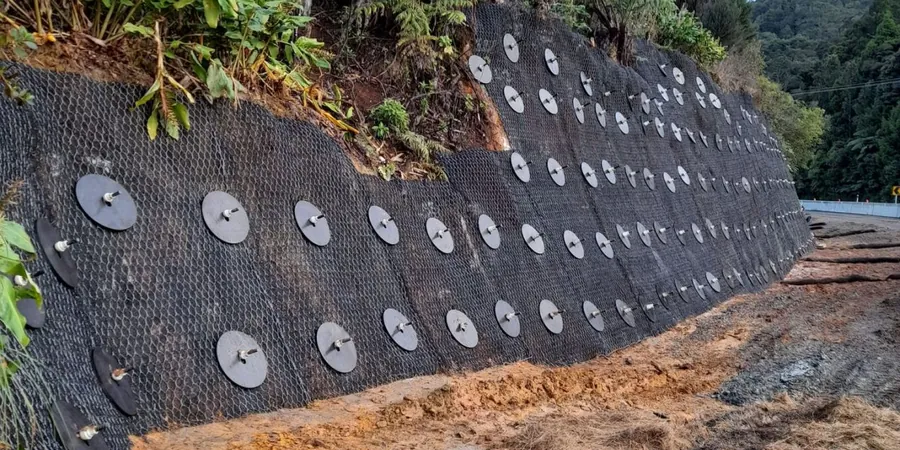
In Houston we often see slopes that look fine after grading but start creeping after a heavy rain. The culprit is usually the high-plasticity clay that swells when wet and shrinks during dry spells. Over the years we have learned that slope stabilization design in Houston must start with a detailed soil profile. That means drilling boreholes, running Atterberg limits, and measuring the natural moisture content. Without that base data any calculated factor of safety is just a guess. Once we know the soil's undrained shear strength we can model the failure surface and decide whether we need a structural wall or a simple regrade. Many times the solution involves improving drainage before reinforcing the slope itself. We often combine our slope work with deep excavations when the toe of the slope sits near a building foundation.
In Houston clay, a slope that looks stable in July can fail in February after a wet winter — we design for the wettest condition, not the driest.
Methodology and scope
Houston sits on about 50 feet of Quaternary alluvium and Beaumont clay, a formation known for its high plasticity index and low permeability. This means slope failures here rarely happen fast — they develop slowly as water builds up pore pressure. During our field investigations we measure piezometric levels and take undisturbed samples for triaxial testing. The results feed into a limit-equilibrium analysis that checks circular and non-circular slip surfaces. For cuts deeper than 15 feet we usually add a drainage system along the bench to prevent hydrostatic uplift. When the existing slope is too steep we recommend flattening or adding a berm. The whole process follows the FHWA guidelines for slope stability and the IBC 2018 provisions for lateral earth pressures.
Technical reference image — Houston
Local considerations
ASCE 7-16 requires site-specific seismic hazard analysis for critical structures in Houston, even though the region is considered low seismicity. The real risk here is not earthquakes but rainfall. Houston averages 49 inches of rain per year, and the clay loses strength dramatically when saturated. We have seen slopes with a static safety factor of 1.6 drop to 1.1 after a week of steady rain. That is why every slope stabilization design in Houston must include a worst-case groundwater scenario. We model the slope using the peak pore pressure recorded during the wet season, not the average. Ignoring this can lead to progressive failure and costly repairs later.
Drilling, sampling, piezometer installation, and lab tests (Atterberg, triaxial, direct shear) to define the soil profile and groundwater regime.
02
Stability Analysis & Design Report
Limit-equilibrium modeling (Bishop, Morgenstern-Price) with seepage analysis, recommended geometry, drainage details, and factor-of-safety calculations.
Applicable standards
ASCE 7-16 (Minimum Design Loads for Buildings), IBC 2018 (Chapter 18 – Soils and Foundations), FHWA-NHI-05-089 (Slope Stability Reference Guide), ASTM D2487 (Classification of Soils for Engineering Purposes)
Frequently asked questions
How much does slope stabilization design cost?
For a typical residential or low-rise commercial slope in Houston the fee ranges between US$1.680 and US$7.000, depending on the number of borings, lab tests, and complexity of the analysis. We can give a more precise number after a quick site visit.
What soil conditions cause most slope failures in Houston?
The Beaumont clay, classified as CH, has high plasticity and low permeability. After prolonged rain, water gets trapped between clay layers, raising pore pressure and reducing effective stress. This is the main trigger for rotational failures in the area.
Do I need a geotechnical report for a small retaining wall?
Yes, if the wall retains more than 4 feet of fill or is built on existing clay slopes. The IBC 2018 requires a soils report for any structure that supports lateral loads. Without it, the wall may lack adequate drainage or embedment depth.
Can you design a vegetated slope instead of a wall?
Absolutely. For slopes with a factor of safety above 1.3 we can recommend erosion control mats, deep-rooted grass, and surface drainage swales. In tighter spaces we use geogrid-reinforced soil slopes, which combine vegetation with internal reinforcement.
Location and service area
We serve projects across Houston and its metropolitan area.