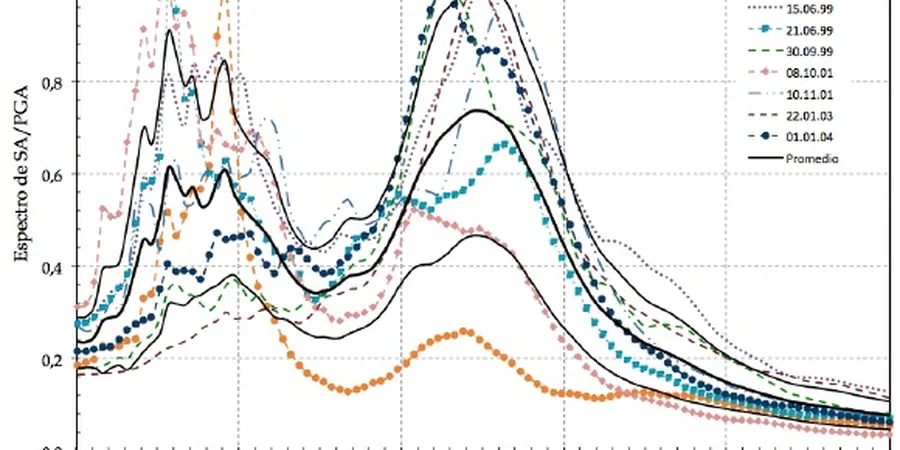
Houston sits on up to 15 km of unconsolidated Tertiary and Quaternary sediments, a deep alluvial sequence that amplifies seismic waves from distant events like the 2011 Oklahoma earthquakes. The Gulf Coast plain's soft clays and loose sands, combined with a shallow water table at 1.5–4.5 m, create a classic basin effect where long-period motions dominate. For any structure over 3 stories or with an Importance Factor ≥ 1.0, IBC and ASCE 7-22 mandate a site-specific ground motion hazard analysis rather than relying on generic NEHRP maps. The key output is the acceleration response spectrum at the ground surface, which directly governs base shear calculations for foundation and superstructure design. This is not a desktop study it requires field measurements of vs30/" data-interlink="1">shear wave velocity via MASW-Vs30 profiling and sometimes downhole seismic testing to capture the stiffness profile of the Beaumont and Lissie formations.
Houston's deep alluvial basin amplifies long-period shaking by 2 to 4 times compared to a rock site, which directly increases design base shear for mid-rise structures.
Methodology and scope
In practice, we start with a microtremor HVSR survey to identify the fundamental site frequency, which in Houston typically falls between 0.4 and 1.2 Hz depending on sediment thickness. Then we run MASW arrays along two perpendicular lines to compute the time-averaged shear wave velocity to 30 m depth (Vs30). The field data feeds directly into a 1D equivalent-linear site response analysis using programs like DEEPSOIL or STRATA. We model the soil profile as multiple visco-elastic layers, each with its own shear modulus reduction and damping curves from Darendeli 2001. The input motion is selected from the NGA-West2 database, scaled to match the ASCE 7-22 target spectrum for the 2% in 50-year hazard level. The output includes peak ground acceleration at surface, spectral accelerations at 0.2s and 1.0s, and the design response spectrum. For projects near the Houston Ship Channel or on hydraulic fill, we also incorporate a liquefaction triggering evaluation using the Youd-Idriss 2001 SPT-based method.
Technical reference image — Houston
Local considerations
What we commonly see in Houston is that engineers underestimate soil nonlinearity. At low strain, the clays appear stiff, but once cyclic shear strains exceed 0.1% during a design earthquake, modulus degradation drops G/Gmax to below 0.5. This means the site can actually soften during shaking, shifting the fundamental period toward the structure's natural period and creating a resonance condition. Ignoring this strain-dependent behavior leads to non-conservative design spectra. Additionally, the high plasticity of Beaumont clay (PI > 40) introduces significant pore pressure buildup even at moderate PGA, which the equivalent-linear method does not capture. That is why for critical facilities we recommend a fully nonlinear analysis with cimentaciones-sismicas to account for cyclic softening and post-earthquake settlement.
We deploy 24-channel landstreamer arrays with 4.5 Hz geophones to map Vs30 across your site. For deep profiles up to 60 m, we use downhole seismic with a borehole source and triaxial geophones at 1.5 m intervals.
02
Input Motion Selection & Scaling
Using the PEER Ground Motion Database, we select 3 to 7 recorded motions from crustal events with magnitude 5.5 to 7.5, scaled to match the ASCE 7-22 target spectrum for the 2% in 50-year hazard level.
03
1D Equivalent-Linear & Nonlinear Analysis
We run DEEPSOIL v7.0 with the Darendeli 2001 modulus reduction and damping curves, performing both equivalent-linear and fully nonlinear analyses to produce strain-compatible acceleration response spectra at the surface.
04
Liquefaction & Cyclic Softening Screening
Using SPT- and Vs30-based methods (Youd-Idriss 2001, Robertson & Wride 1998), we evaluate the potential for liquefaction in loose sands and cyclic softening in high-PI clays under the design earthquake.
In Houston, Vs30 values typically fall between 180 and 350 m/s, which classifies most sites as NEHRP Site Class D (stiff soil) or E (soft soil). The lowest values occur in areas with thick Beaumont clay and near the coast, while higher values are found where the Pleistocene Lissie formation is closer to the surface.
How does the deep alluvial basin affect ground motion in Houston?
Houston's sedimentary basin, up to 15 km thick, traps and amplifies seismic waves. Long-period energy (T > 0.5 s) can be amplified by a factor of 2 to 4 compared to a rock site. This effect is not captured by generic NEHRP maps, which is why ASCE 7-22 requires site-specific analysis for structures with a fundamental period above 0.5 s.
What is the cost range for a site response analysis in Houston?
A comprehensive site response analysis in Houston typically ranges between US$1,190 and US$3,880, depending on the number of input motions, the depth of Vs30 profiling required, and whether a full nonlinear analysis is needed. The cost includes field testing, laboratory calibration of modulus reduction curves, and a final report with design spectra.
When is a fully nonlinear analysis preferred over equivalent-linear?
A fully nonlinear analysis is recommended when peak ground acceleration at rock exceeds 0.10 g, when the soil profile contains thick layers of high-PI clay (PI > 40), or when the structure is in Seismic Design Category D or higher. Equivalent-linear methods underestimate pore pressure buildup and cyclic softening in these conditions, leading to unconservative design.
Location and service area
We serve projects across Houston and its metropolitan area.