Houston sits on the Gulf Coastal Plain, where the geology is dominated by alluvial clays and the Beaumont Formation. These clay-rich soils have a high plasticity index, often exceeding 50 in the upper 15 feet. That makes expansive soil evaluation a non-negotiable step for any slab-on-grade or shallow foundation. We measure Atterberg limits and volumetric strain under controlled moisture changes. The city's flat topography and heavy rainfall cycles amplify the shrink-swell hazard. Without proper data, post-construction heave or settlement can exceed 4 inches.
In Houston clays, a 2% change in water content can generate enough swell pressure to crack a reinforced slab.
Methodology and scope
We start with undisturbed block samples extracted from test pits at 2- to 5-foot intervals. The lab runs free swell tests and swell pressure tests per ASTM D4546. We also measure suction using the filter paper method (ASTM D5298) to estimate in-situ moisture deficit.
Swell pressure above 100 kPa usually requires mitigation like lime-cement stabilization or moisture barriers.
For deep profiles, we combine this data with borehole sampling from SPT rigs. The final report includes a diffusion coefficient for moisture migration modeling.
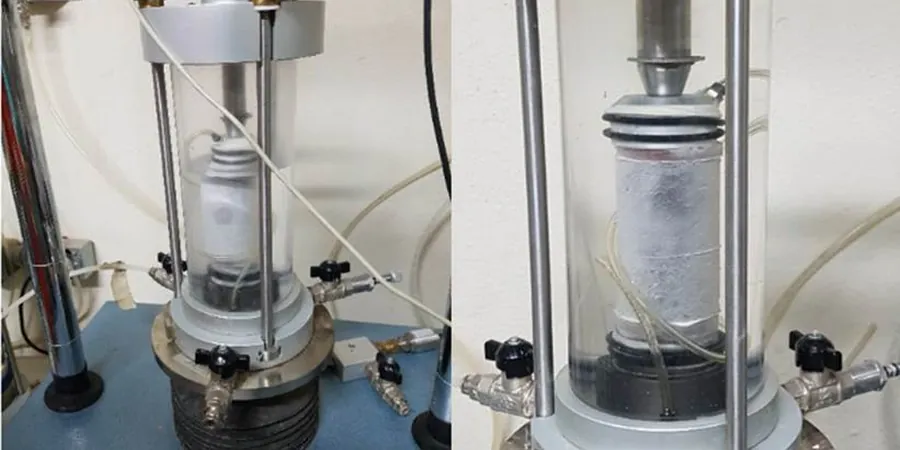
Technical reference image — Houston
Local considerations
Houston's humid subtropical climate brings 50 inches of rain per year, followed by months of drought. That wet-dry cycle is the engine of soil expansion. When clay dries, it shrinks and cracks. Then rainwater infiltrates through those cracks, swelling the mass from within. The risk is differential movement under foundations. We model this using the Thornthwaite Moisture Index (TMI) for Houston, which ranges from 20 to 40. This data feeds directly into the foundation design for edge lifts and center lifts.
One-dimensional odometer tests on undisturbed specimens. We report swell percentage under a 1 kPa seating load and swell pressure at constant volume. Standard turn-around is 10 business days.
02
Moisture-Suction Characterization
Filter paper and chilled-mirror dewpoint methods to develop the soil-water characteristic curve. This is critical for unsaturated flow modeling and foundation moisture design.
03
Mitigation Design Support
Based on test results, we recommend pre-wetting, moisture barriers, or deep foundation alternatives. We coordinate with structural engineers to set the depth of grade beams and void space requirements.
What is the difference between swell pressure and free swell?
Free swell measures how much a soil expands vertically under a light load (typically 1 kPa) when inundated. Swell pressure measures the stress required to prevent any volume change during wetting. Both are needed for foundation design in Houston clays.
How much does expansive soil evaluation cost in Houston?
A full evaluation including sampling, Atterberg limits, and one-dimensional swell testing typically ranges between US$670 and US$1,880. The final cost depends on the number of test locations and the depth of the profile. Contact us for a project-specific quote.
How long does it take to get test results?
Standard testing takes 10 to 12 business days from sample receipt. Swell pressure tests require full saturation and stabilization, which adds 3 to 5 days. Rush service is available for an additional fee.
Do I need a deep foundation if the soil is expansive?
Not always. If swell pressure is moderate (below 100 kPa) and the active zone is shallow (less than 8 ft), a stiffened slab with moisture barriers can work. Our evaluation will define the active zone depth and swell pressure profile so the structural engineer can choose the right system.
What ASTM standards apply to expansive soil testing?
The primary standards are ASTM D4318 for Atterberg limits, ASTM D4546 for one-dimensional swell and swell pressure, and ASTM D5298 for filter paper suction. For classifying expansion potential, we also reference the Unified Soil Classification System (ASTM D2487).
Location and service area
We serve projects across Houston and its metropolitan area.