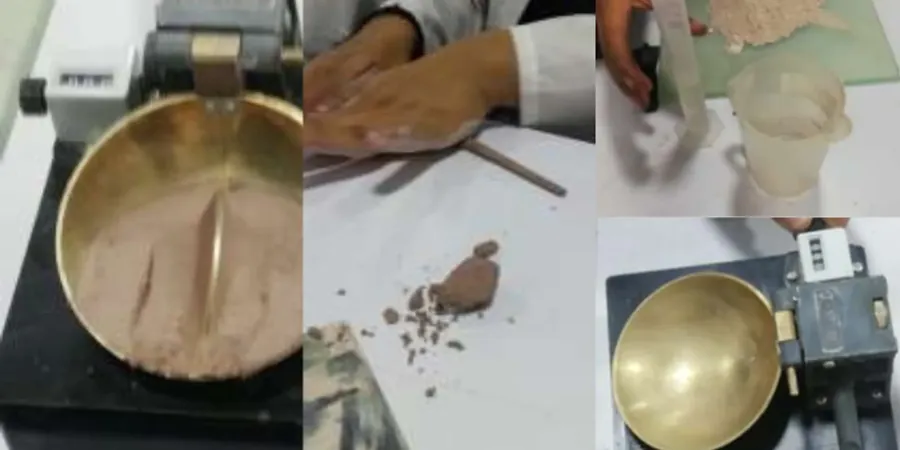
Houston sits on deep deposits of Beaumont clay, a highly plastic formation that swells when wet and shrinks during drought. ASTM D4318 governs the determination of liquid limit, plastic limit, and plasticity index — the three Atterberg limits that define how a fine-grained soil behaves under changing moisture. For any project in Houston, knowing these values early prevents costly foundation movements. We perform the test on disturbed samples recovered from boreholes or test pits, using the Casagrande cup for liquid limit and the thread-rolling method for plastic limit. The results feed directly into the Unified Soil Classification System (ASTM D2487), which local engineers rely on for slab-on-grade and deep foundation design. Before moving to structural analysis, we often combine Atterberg limits with a granulometry test to classify the full particle-size distribution.
Houston's Beaumont clay regularly exceeds PI 40, making Atterberg limits the single most cost-effective test for predicting foundation performance on expansive soils.
Methodology and scope
A typical commercial building in the Energy Corridor needs at least one Atterberg limits test per soil stratum encountered during drilling. The procedure is straightforward: a sample is air-dried, sieved through a No. 40 mesh, then mixed with distilled water to a paste consistency. For the liquid limit, we cut a groove with the Casagrande tool and count the number of drops until the groove closes — that moisture content is the liquid limit. For the plastic limit, we roll threads until they crumble at 3.2 mm diameter. The difference between both limits is the plasticity index, a direct indicator of swelling potential. Houston clays commonly show plasticity indices above 40, which classifies them as CH (high plasticity clay) under USCS. That number drives decisions on lime stabilization or over-excavation. We also correlate these results with suelos expansivos studies to recommend moisture barriers or replacement depths.
Technical reference image — Houston
Local considerations
The primary risk in Houston is ignoring the shrink-swell cycle of the Beaumont formation. After prolonged drought, the clay desiccates and cracks deeply; when rains return, it expands with enough force to lift slab edges and crack masonry. Atterberg limits quantify that potential. A PI above 35 means the soil is highly expansive — a red flag for any shallow foundation. The International Building Code (IBC) requires site-specific geotechnical investigation for buildings on expansive soils, and Atterberg limits are the baseline test to trigger that deeper analysis. Without them, you might design a foundation that works on paper but fails within two seasonal cycles. Pairing this data with a capacidad-de-carga study gives you the full picture for safe footing design.
Precision test using the standard brass cup and grooving tool per ASTM D4318. Results reported at 25 blows with moisture content to 0.1% accuracy.
02
Plastic Limit and Plasticity Index
Thread-rolling method to determine plastic limit, followed by PI calculation. Includes classification per USCS and AASHTO for expansive soil assessment.
03
Combined Atterberg + Classification Package
Liquid limit, plastic limit, PI, natural moisture content, and USCS classification in a single report. Ideal for preliminary geotechnical evaluations in Houston subdivisions.
Applicable standards
ASTM D4318-17e1: Standard Test Methods for Liquid Limit, Plastic Limit, and Plasticity Index of Soils, ASTM D2487-17: Standard Practice for Classification of Soils for Engineering Purposes (Unified Soil Classification System), IBC 2021 Section 1803.5.5: Expansive Soils – requires determination of plasticity index for site characterization
Frequently asked questions
How much does Atterberg limits testing cost in Houston?
The typical range for a complete set (liquid limit, plastic limit, and plasticity index) is US$60 to US$80 per sample. Volume discounts apply for multi-borehole projects.
How long does it take to get results?
Standard turnaround is 2 to 3 business days after the lab receives the sample. Rush service with same-day results is available for an additional fee.
Do you accept samples collected by third-party drillers?
Yes, we accept disturbed bag samples from any qualified drilling contractor. The sample must be labeled with project name, borehole number, depth, and date. We log receipt in our chain-of-custody system.
Why are Atterberg limits important for Houston's clay soils?
Houston's Beaumont and Lissie formations contain high-plasticity clays that swell and shrink with seasonal moisture changes. Atterberg limits provide the plasticity index, which directly correlates to the soil's expansion potential. A PI above 35 typically requires special foundation measures per IBC and local building codes.
Location and service area
We serve projects across Houston and its metropolitan area.