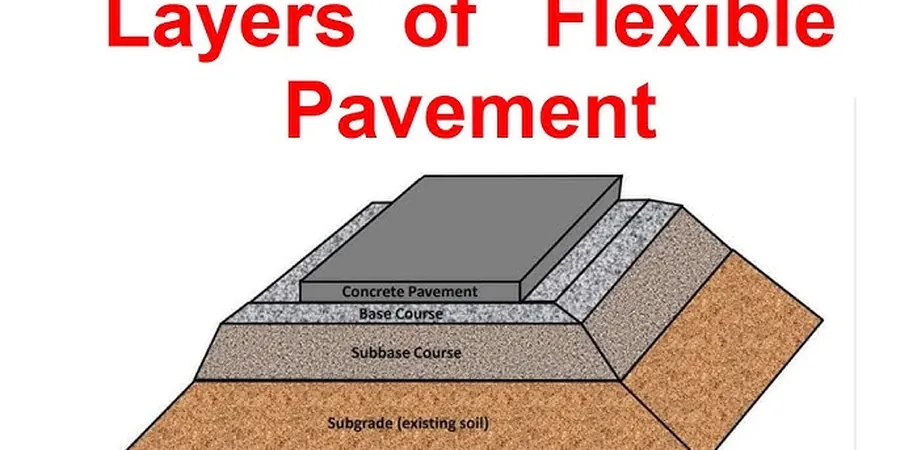
When our team rolls out the dynamic cone penetrometer and the automated asphalt compactor on a Houston job site, we are not just running standard equipment. The Gulf Coast region demands a different approach to flexible pavement design because the native Beaumont clay behaves nothing like the sandy soils you find further inland. We start every project by drilling test pits with a track-mounted rig to log soil stratification down to at least five feet. That initial physical inspection tells us more about moisture content and plasticity than any spreadsheet ever could. Before we even talk about asphalt thickness, we run a CBR test on undisturbed samples to establish a baseline bearing capacity for the subgrade.
A flexible pavement section that ignores Houston's expansive clay can crack within two wet-dry cycles, leading to structural failure before the first warranty expires.
Methodology and scope
Houston sits on approximately 50 feet of highly plastic clay overlying the Lissie Formation, a geological reality that makes flexible pavement design here a distinct challenge. The local clay shrinks and swells with seasonal rainfall — we see volumetric changes of up to 15 percent in some blocks near the Buffalo Bayou. To counter that movement, we recommend a stabilized subbase layer of at least 10 inches of crushed limestone, compacted to 98 percent of the modified Proctor density. For projects near the Ship Channel where groundwater sits at three feet, we incorporate a drainage blanket to prevent water from weakening the base. We also cross-check our pavement section with a plate load test on the finished subgrade to confirm the modulus of subgrade reaction before placing the hot mix.
Technical reference image — Houston
Local considerations
The most common mistake we see in Houston is treating flexible pavement design as a simple thickness calculation while ignoring the subgrade's reaction to moisture. A contractor once placed six inches of asphalt over untreated clay on a residential street in Katy — within eight months the surface had alligator cracking and edge drop-offs that required full reconstruction. The real risk is differential settlement caused by localized clay heave under the pavement section. Without a proper geotechnical investigation that includes Atterberg limits and swell-consolidation tests, you are essentially gambling on the pavement's long-term ride quality and structural integrity.
We drill test pits and boreholes to log soil types, collect undisturbed samples for laboratory CBR, Atterberg limits, and swell testing. This data forms the foundation for every pavement thickness calculation.
02
Pavement Section Design & Optimization
Using AASHTO 93 methodology calibrated to Houston traffic counts, we determine the optimal combination of asphalt depth, base thickness, and subbase treatment to balance cost and durability.
03
Drainage & Moisture Control Plan
We design edge drains, underdrains, and subgrade capping layers to keep water away from the pavement structure. For sites with high water tables, we recommend granular drainage blankets tied to stormwater outfalls.
Applicable standards
TxDOT Item 340 (Flexible Pavement Design), AASHTO Guide for Design of Pavement Structures (1993, with 1998 supplement), ASTM D1883 (CBR Test for Subgrade Soils)
Frequently asked questions
What is the typical cost range for a flexible pavement design study in Houston?
For a standard project covering one to four lane-miles of roadway, the geotechnical investigation and design report typically falls between US$1.480 and US$5.360. The final cost depends on the number of test pits required, laboratory testing volume, and the complexity of drainage design.
Why does Houston clay require a thicker base layer than other regions?
Houston's Beaumont clay has a plasticity index that often exceeds 40, meaning it expands significantly when wet and contracts when dry. A thicker crushed limestone base distributes traffic loads more evenly and acts as a capillary break, reducing moisture migration into the subgrade. Without that buffer, the pavement surface can develop severe cracking within two years.
How does the AASHTO 93 method apply to flexible pavement design in Houston?
The AASHTO 93 method uses structural number, subgrade resilient modulus, and traffic load (ESALs) to determine the required pavement thickness. In Houston, we typically adjust the subgrade modulus downward by 30-40 percent to account for the clay's low soaked CBR and high swell potential. This conservative approach extends pavement life despite the challenging soil conditions.
Can flexible pavement be used on Houston's major arterial roads like I-10 or the Sam Houston Tollway?
For high-traffic arterials carrying over 30 million ESALs, TxDOT typically specifies rigid pavement (concrete) because it distributes loads more efficiently on weak subgrades. Flexible pavement is best suited for collector streets, residential roads, parking lots, and light-industrial access roads where traffic volumes are moderate and budget constraints favor asphalt.
What site conditions would require switching from flexible to rigid pavement design in Houston?
If the subgrade CBR is below 2 after stabilization attempts, or if the water table remains within three feet of the surface year-round, rigid pavement often becomes the more reliable option. Flexible pavement relies on the subgrade for structural support, whereas concrete slabs can span weak spots better. We always evaluate both options during the design phase and present a cost-benefit comparison to the client.
Location and service area
We serve projects across Houston and its metropolitan area.