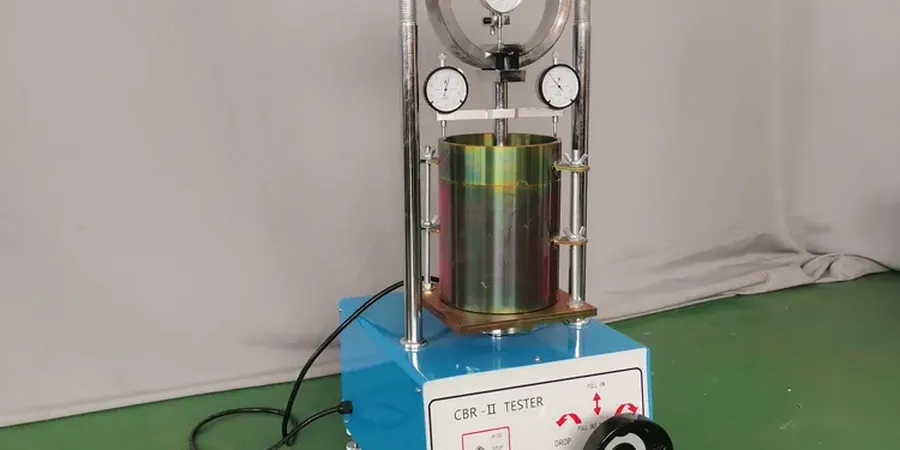
Houston sits on roughly 50 feet of Quaternary alluvial deposits over the Beaumont Formation — clay-rich soils that shrink, swell, and soften when wet. For any pavement or platform design in this region, the laboratory CBR test is the core parameter we use to evaluate subgrade strength. Our test follows ASTM D1883-16, compacting the sample at optimum moisture before soaking it for 96 hours to simulate worst-case saturation. We then measure penetration resistance and calculate the CBR value at 0.1-inch and 0.2-inch deflection. That single number drives the thickness of every asphalt layer and base course we specify for Houston projects. Before running the CBR, we often classify the soil with a granulometry test to understand the grain-size distribution that controls drainage and compaction behavior.
On Houston's CH clays, soaked CBR values typically land between 1.5 and 4 — without treatment, pavement thickness becomes uneconomical.
Methodology and scope
High-plasticity clays (CH) dominate the top 15 feet across most of Houston, with liquid limits frequently exceeding 60. These soils lose up to 80% of their strength when saturated. That is why the soaked CBR value — not the unsoaked — is the number we use for design. The laboratory CBR test on Houston clays typically returns values between 1.5 and 4, which means significant pavement thickness unless we treat the subgrade. We mix the sample to target field density and moisture, then soak it under a surcharge load that replicates overburden pressure. The penetration piston advances at 0.05 inches per minute, and we record load at every 0.025 inches. For projects where swelling is a concern, we measure the expansion during the 96-hour soak and cross-check it with a suelos expansivos study to decide whether chemical stabilization is needed before the pavement layer is placed.
Technical reference image — Houston
Local considerations
Houston's rapid postwar expansion pushed developments onto clay flats and former marshlands where drainage was minimal. Builders backfilled with whatever was available — construction debris, organic silt, even trash. That legacy creates a nightmare for pavement design: variable subgrade, hidden soft spots, and erratic CBR values across the same lot. If you only test one location, you risk designing a pavement that fails in the next block. We recommend one laboratory CBR test per 500 square yards of pavement area, plus a visual classification of every sample to catch those anomalies early. Missing a weak zone means premature cracking, patching costs, and liability that far exceeds the testing expense.
Full four-day soak with expansion measurement; reported at 0.1-in and 0.2-in penetration. Includes compaction proctor for OMC/MDD. Turnaround: 5 business days.
02
Rapid Unsoaked CBR Screening
Compacted at optimum moisture, tested immediately without soaking. Used for preliminary design or quality control when saturated conditions are not expected. Turnaround: 48 hours.
Applicable standards
ASTM D1883-16 (Standard Test Method for CBR of Laboratory-Compacted Soils), AASHTO T 193-13 (Standard Method of Test for the California Bearing Ratio), ASTM D698-12 (Standard Proctor compaction), ASTM D1557-12 (Modified Proctor compaction)
Frequently asked questions
How does the laboratory CBR test work for Houston clay soils?
We compact the soil sample at its optimum moisture content inside a 6-inch mold, then soak it in water for 96 hours under a 4.54 kg surcharge. After soaking, we measure the force required to push a 1.954-inch-diameter piston into the sample at 0.05 inches per minute. The CBR value is the ratio of that force to the standard force for crushed stone, expressed as a percentage. For Houston's CH clays, soaked CBR values usually fall between 1.5 and 4.
What is the difference between soaked and unsoaked CBR?
The soaked CBR test simulates worst-case saturation by submerging the sample for four days before penetration. This gives a lower, more conservative value that accounts for strength loss in wet conditions — critical for Houston's high-plasticity clays. The unsoaked test skips the soaking step and returns higher values. We only use unsoaked results for dry climates or temporary pavements. For permanent roads in Houston, always use the soaked CBR.
How many CBR tests do I need for a Houston pavement project?
We recommend a minimum of one laboratory CBR test per 500 square yards of pavement area, plus at least one per distinct soil layer encountered in the borings. If the subgrade varies across the site — common in Houston due to fill pockets — increase the frequency. The AASHTO pavement design method is sensitive to CBR variability, so more tests mean a more reliable design thickness.
What is the typical cost of a laboratory CBR test in Houston?
The price for a standard soaked CBR test including compaction proctor ranges between US$120 and US$210 per sample, depending on volume and turnaround time. The unsoaked screening test is slightly lower. We recommend contacting us with your project scope for a firm quote.
Location and service area
We serve projects across Houston and its metropolitan area.