Houston grew fast after the 1900 Spindletop oil boom. The city spread across the flat coastal plain of the Gulf Coast. That flatness is a problem. Rainwater sits. The clay-rich soils, especially the Beaumont and Lissie formations, swell when wet and shrink when dry. Early developers often ignored drainage. They paid later with cracked slabs and flooded streets. Today, geotechnical drainage design in Houston starts with understanding how water moves through these tight clays. A system that works in Denver or Seattle will fail here. We see it often. The key is controlling subsurface water before it reaches the foundation. That means combining surface grading with deep drainage elements. For sites near Buffalo Bayou or the Ship Channel, groundwater is shallow. We always check the seasonal high water table first. Then we design drains that handle both storm events and long-term seepage. Proper geotechnical drainage design in Houston is not optional. It is the difference between a building that lasts and one that settles unevenly every spring.
Water moves through Houston clay like through a brick wall. Design drainage for permeability below 10⁻⁶ cm/s or watch your slab settle.
Methodology and scope
In Houston, many times we see contractors add gravel and call it drainage. That is not enough. The clay here has permeability below 10⁻⁶ cm/s. Water moves through it like through a brick wall. A real geotechnical drainage design in Houston must account for that low permeability. We usually install prefabricated vertical drains or trench drains tied to a sump system. Before that, we run field infiltración tests to measure actual percolation rates. We also map soil stratification with test pits. A sand lens at 10 feet can carry water sideways under your slab. You need to intercept it. On large sites like the Energy Corridor, we combine drainage with precarga to consolidate the clay before building. The sequence matters: drain first, then preload, then build. Each project gets a site-specific water balance. We calculate runoff, infiltration, and evapotranspiration for a 100-year storm. That is not a suggestion. It is required by local floodplain ordinances.
Technical reference image — Houston
Local considerations
The biggest mistake builders make in Houston is skipping drainage design until after the foundation is poured. They assume the slab will bridge over wet clay. It won't. The clay swells. It heaves. Cracks appear. Another error is using perforated pipe without a filter sock. Fine clay particles wash in and clog the system in two years. Then water backs up and saturates the subgrade. We have seen parking garages in Midtown that lost bearing capacity because the drainage failed. The cost to retrofit is three times the original design. A proper geotechnical drainage design in Houston prevents all that. It is cheaper to do it right once.
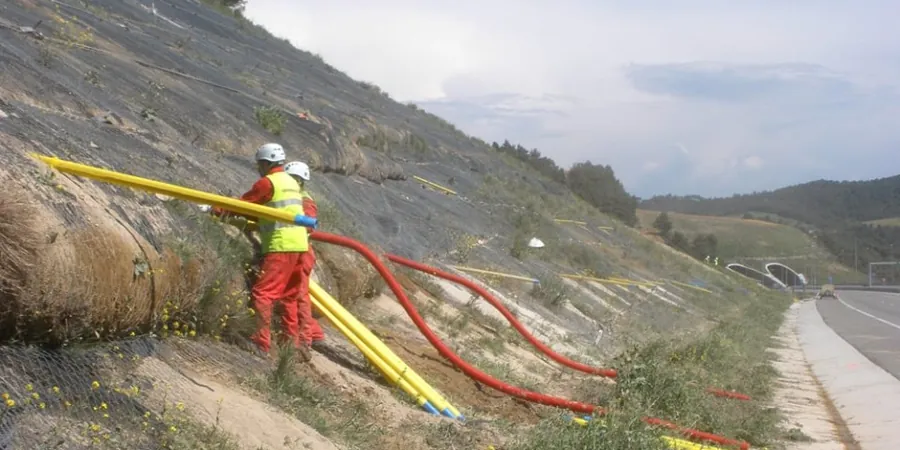
We design trench drains, prefabricated vertical drains, and collector pipes based on soil permeability and water table depth. Layouts include filter specifications and outlet routing to storm sewers or retention ponds.
02
Groundwater Control Plans
For deep excavations or below-grade structures, we design dewatering systems, sump pits, and cutoff walls. We model drawdown rates to avoid settlement of adjacent properties.
03
Surface Water Management Integration
We coordinate drainage design with site grading, curb inlets, and detention ponds. The goal is zero ponding on the slab and positive runoff away from the foundation.
04
Long-Term Performance Monitoring
We install piezometers and flow meters to verify drainage performance after construction. Data is reviewed annually to detect clogging or water table rise before it causes damage.
Applicable standards
IBC 2018 Chapter 18 (Foundation and Drainage), ASTM D6391 (Field Permeability in Place), FHWA NHI-06-088 (Subsurface Drainage Design), ASCE 7-16 (Rainfall and Flood Loads)
Frequently asked questions
What is the typical cost for geotechnical drainage design in Houston?
For a standard residential or small commercial site, the design phase typically ranges from US$930 to US$2,180. This includes field testing, modeling, and a stamped drainage plan. Larger projects with multiple drainage zones or deep excavations cost more due to added modeling complexity.
Why is drainage design more critical in Houston than in other cities?
Houston sits on expansive clay with very low permeability. Water from heavy rain or flood events cannot drain naturally. It stays in the soil, causing clay to swell and foundations to heave. Without a designed drainage system, slabs crack and walls shift. The city's flat topography means there is no gravity outlet, so every drop must be pumped or piped away.
What codes govern drainage design in Houston?
The primary code is the 2018 International Building Code (IBC), Chapter 18, which covers foundation drainage and subgrade preparation. The City of Houston also enforces local floodplain ordinances that require a 100-year storm event analysis. ASTM D6391 is used for field permeability testing. FHWA NHI-06-088 provides guidance for subsurface drainage systems.
How long does a drainage design project take?
A typical design takes two to four weeks. The first week is for site investigation: test pits, permeability tests, and water table monitoring. The second week is for modeling and drafting the drainage layout. The final week includes review, revisions, and stamping by the licensed engineer. Complex sites with multiple drainage zones may take six weeks.
Can drainage design fix an existing foundation that is already heaving?
Yes, but it is more expensive than designing it upfront. We install perimeter drains, sump pumps, and sometimes vertical drains around the foundation to draw down the water table. The soil must be allowed to dry and consolidate before any slab repair is attempted. In severe cases, we recommend underpinning after drainage is in place. The cost is typically 2–3 times the original drainage design.
Location and service area
We serve projects across Houston and its metropolitan area.