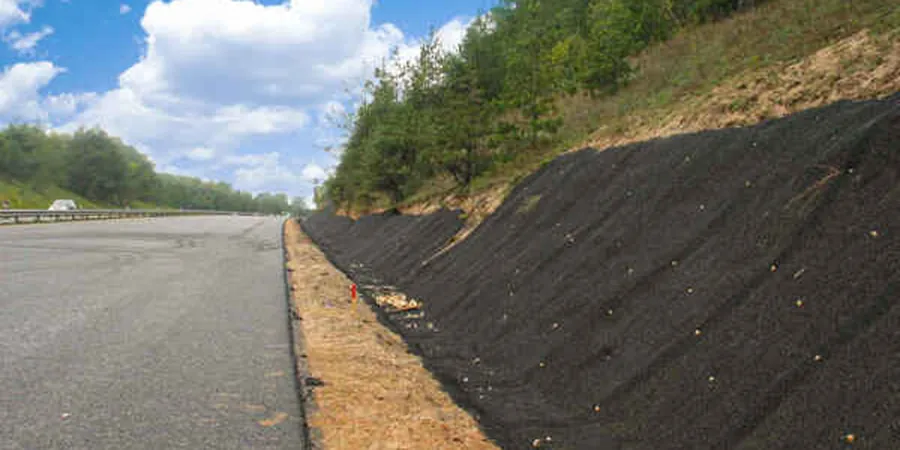
Houston sits on thick Beaumont clay, a high-plasticity formation that shrinks and swells with seasonal moisture changes. When we design a road embankment here, we cannot simply place fill and compact it — the subgrade itself will move. A proper embankment design must account for the soil's volumetric instability and the region's flat topography, which limits natural drainage. Before placing any fill, we run a subgrade investigation to map the clay profile and evaluate its expansion potential. That baseline data drives the fill selection, lift thickness, and moisture conditioning needed for a durable structure. Without it, even a well-compacted embankment can crack or settle unevenly within the first wet-dry cycle.
Ignoring clay expansion in Houston embankment design leads to differential settlement within one wet-dry cycle; proper moisture conditioning is the only defense.
Methodology and scope
A common mistake contractors make in Houston is compacting fill at standard Proctor optimum without adjusting for clay plasticity. The Beaumont formation often requires moisture conditioning 2 to 4 points above optimum to reduce swell pressure. Our embankment design protocol follows ASTM D698 for compaction and ASTM D4318 for Atterberg limits on every borrow source. We also evaluate the subgrade's California Bearing Ratio (CBR) through the ensayo CBR to confirm that the embankment base can support pavement loads. The process includes:
Slope stability analysis using Bishop's simplified method for side slopes up to 2.5H:1V
This systematic approach prevents post-construction distress that would otherwise require costly remediation.
Technical reference image — Houston
Local considerations
Houston's high water table and intense rainfall events create a unique risk for embankments. When a fill is placed over saturated clay, pore pressures can rise rapidly, reducing effective stress and triggering slope failures. We have seen cases where a 15-foot embankment failed during a single 12-inch storm because the drainage layer was omitted. To mitigate this, every embankment design we deliver includes a subgrade drainage blanket connected to perimeter ditches, and we specify geotextile separation between fill and native soil to prevent intermixing. The flat coastal plain leaves no room for error — water has nowhere to go unless we design the path.
Boreholes and test pits to classify Beaumont clay profiles, measure natural moisture, and assess expansion potential. Includes Atterberg limits and sieve analysis per ASTM D4318 and D6913.
02
Compaction Control & Moisture Conditioning
Proctor curves, field density testing (nuclear gauge or sand cone), and moisture adjustment recommendations to achieve 95% of maximum dry density while controlling swell.
03
Slope Stability & Settlement Analysis
Limit-equilibrium slope stability using Bishop's method, plus consolidation settlement estimates for fill heights above 10 feet. Reports include factor-of-safety contours and recommended side slopes.
04
Drainage & Reinforcement Design
Geocomposite drainage layers, blanket drains, and geogrid reinforcement specifications to manage pore pressure and distribute loads over weak subgrades.
What is the typical cost range for a road embankment design study in Houston?
A full geotechnical investigation and design for a road embankment in Houston typically ranges between US$1,150 and US$4,450, depending on the number of borings, laboratory tests required, and whether slope stability analysis is included. Site access and fill volume also affect the final quote.
How do you handle expansive clay under an embankment in Houston?
We first measure the clay's swell index and free swell under a surcharge equivalent to the embankment load. If swell pressure exceeds the overburden, we recommend moisture conditioning the fill 2-4 points above optimum, or using a geosynthetic barrier to isolate the fill from the active clay zone. For severe cases, preloading with a temporary surcharge can consolidate the clay before permanent fill placement.
What slope ratio is recommended for embankments on Beaumont clay?
For embankments up to 20 feet on Beaumont clay, we typically specify side slopes of 2.5H:1V for long-term stability and 3H:1V if the embankment will be subjected to rapid drawdown or heavy rainfall. Steeper slopes require geogrid reinforcement or a berm at the toe. Our analysis always includes a minimum factor of safety of 1.5 per IBC for the long-term drained condition.
Location and service area
We serve projects across Houston and its metropolitan area.