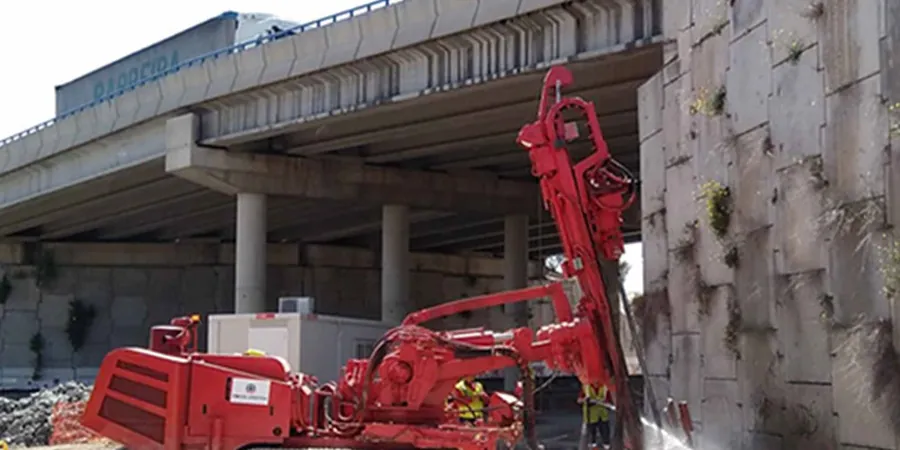
Houston's flat coastal plain sits on a thick sequence of interbedded clays, sands, and gravels that shift with every heavy rain. The expansive Beaumont Clay can swell over a foot when saturated, then shrink and crack during dry spells, opening pathways for water to flow where it should not. Add the network of bayous and the city's vulnerability to tropical storms, and you get a subsurface that demands careful sealing. That is where grouting design enters the picture. We inject fluid materials into voids, fractures, or granular soils to reduce permeability, increase strength, or control movement. Before we design a grouting program, we always run a geotechnical study to map the exact conditions. Without that data, even the best grout mix can fail.
Permeation grouting can reduce hydraulic conductivity in Houston sands from 10⁻² cm/s to below 10⁻⁵ cm/s in a single pass.
Methodology and scope
Houston spans roughly 670 square miles and has about 2.3 million residents, but its geology is surprisingly uniform. The standard profile includes 10–30 feet of stiff to very stiff clay over dense sand and gravel. However, old stream channels, buried utility trenches, and abandoned oil-field pits create local anomalies that can ruin a grouting job. We handle four main techniques here.
Permeation grouting – low-viscosity grout fills pores in sand or gravel without disturbing the soil structure.
Compaction grouting – stiff, low-slump grout displaces and densifies loose zones, ideal for sinkhole remediation.
Jet grouting – high-pressure erosion and mixing create columns of soil-cement for excavation support or underpinning.
Chemical grouting – fast-setting resins or silicates seal flowing water in fissured clay or rock.
Each method requires site-specific mix design, injection pressure control, and real-time monitoring. For projects near Buffalo Bayou or the Ship Channel, we also evaluate drainage conditions to prevent hydrostatic pressure from undermining the grout curtain.
Technical reference image — Houston
Local considerations
The biggest mistake we see contractors make in Houston is assuming one grout mix fits every layer. They inject a cement-water slurry into a sand pocket that has 40% void ratio, then wonder why the grout bleeds out through the clay cracks. The result is a bill for thousands of gallons of wasted grout and a foundation that still leaks. Another common error is ignoring the confining pressure. Houston's high groundwater table, often only 5–10 feet deep, can lift grout columns if the injection rate exceeds the soil's fracture gradient. We design stage injection with packers to control the flow path and avoid surface heave or hydrofracture.
0.6:1 to 1.5:1 by weight (permeation); 0.3:1 to 0.5:1 (compaction)
Grout cover depth
3–50 ft (limited by access and overburden pressure)
Target void ratio (sands)
Fill 60–80% of pore space for permeability reduction
Set time control
30 sec to 2 hours (chemical); 2–24 hours (cementitious)
Associated technical services
01
Permeation Grouting Design
Low-pressure injection of cement or chemical grouts into sands and gravels to reduce permeability. We design the mix rheology and injection sequence based on grain-size distribution and Darcy's law.
02
Compaction Grouting Design
High-pressure injection of stiff, low-slump grout to densify loose soils and fill voids. Typical for sinkhole repair, settlement mitigation, and liquefaction remediation near the Ship Channel.
03
Jet Grouting Design
High-velocity erosion and mixing of soil with cement slurry to form soil-cement columns. Used for excavation support, underpinning, and cutoff walls in Houston's soft clays.
04
Chemical Grouting Design
Fast-setting resins and silicates for sealing flowing water in fissured clay or rock. Ideal for tunnel shafts, below-grade parking garages, and deep foundation excavations.
Applicable standards
ASCE 7-16 (Minimum Design Loads and Associated Criteria for Buildings), IBC 2021 (Chapter 18 – Soils and Foundations), ASTM D5092-16 (Standard Practice for Design and Installation of Groundwater Monitoring Wells – grout seal guidelines), ASCE Grouting Committee Guidelines (2017)
Frequently asked questions
What is the typical cost range for grouting design in Houston?
The total project cost for grouting design and execution in Houston typically ranges from US$1,310 to US$4,630 per zone, depending on depth, volume of grout, and access constraints. This includes site investigation, mix design, injection monitoring, and quality control testing.
How does Houston's expansive clay affect grouting performance?
Expansive clay shrinks and cracks during dry weather, creating preferential flow paths for grout to escape. We address this by pre-wetting the clay zone and using low-viscosity chemical grouts that penetrate microfissures before they close. Cement grouts with high water-cement ratios can also be used, but they require slower injection rates to avoid fracturing the clay matrix.
What is the difference between permeation and compaction grouting?
Permeation grouting fills the pore spaces in granular soil without displacing the soil particles. It works best in clean sands and gravels with porosity above 25%. Compaction grouting uses a very stiff grout that pushes soil aside, densifying it. This method is better for loose fills, sinkholes, or zones with large voids where permeation grout would simply flow away.
Do I need a geotechnical report before grouting design?
Absolutely. Every grouting design we produce relies on a geotechnical investigation that includes borings, SPT N-values, grain-size curves, and Atterberg limits. Without those, we cannot calculate the grout take, injection pressure, or mix proportions. We can coordinate the investigation or work with your existing report — just give us a call.
Location and service area
We serve projects across Houston and its metropolitan area.