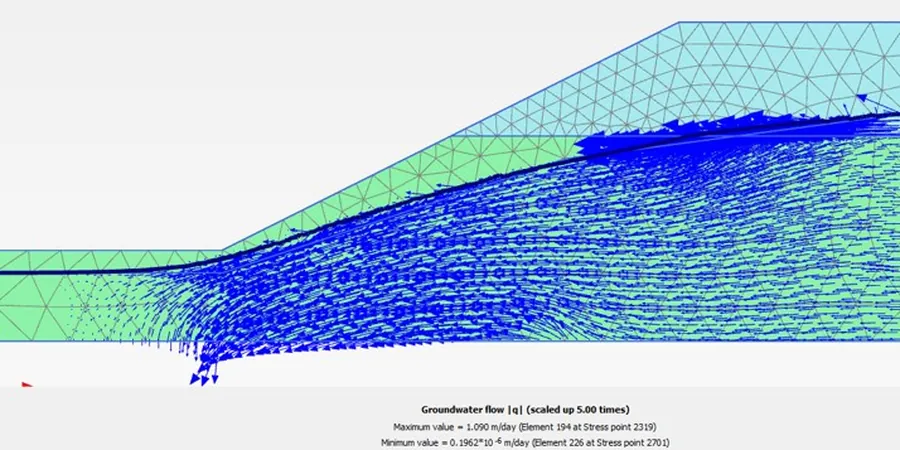
Houston's flat coastal plain and high clay content create unique slope stability challenges. The region's expansive Beaumont and Lissie formations shrink and swell with moisture changes, weakening cut slopes and embankments over time. After heavy rainfall events, water infiltration accelerates pore pressure buildup, often triggering rotational or block slides along pre-existing shear zones. We combine limit equilibrium methods with finite element modeling to evaluate failure mechanisms specific to Houston's subsurface conditions. Before any slope intervention, we recommend a soil classification to identify clay plasticity and potential for volumetric change.
In Houston clays, a 0.05 drop in factor of safety can turn a stable 2:1 slope into an active failure surface within one wet season.
Methodology and scope
Our field team deploys slope inclinometers, piezometers, and survey prisms to monitor real-time movement and pore pressure trends across Houston sites. For each project, we install casings to depths reaching stable strata below the failure plane. Readings are taken weekly during wet months and monthly in dry periods. The data feeds into SLOPE/W and Slide models calibrated with local shear strength parameters. We run both Bishop simplified and Spencer's method analyses to bracket the factor of safety. Below is a summary of typical parameters considered in our Houston slope failure studies.
Technical reference image — Houston
Local considerations
Houston's explosive growth since the 1960s pushed development into former prairie and floodplain areas with poor drainage. Many subdivisions were built on cut-and-fill slopes without adequate subsurface investigation. The result: chronic shallow failures in residential backyards and along roadway embankments. Adding to this, seasonal drought cycles desiccate the clay, creating deep tension cracks that funnel water directly into the slope mass. When rains return, the softened clay loses strength rapidly. A slope that looked fine in July can fail catastrophically by October. We have seen this pattern repeat across neighborhoods like Meyerland and the Energy Corridor.
Bishop, Spencer, and Morgenstern-Price methods using SLOPE/W. We model circular and non-circular failure surfaces, including tension cracks and water table fluctuations.
02
Finite Element Modeling
PLAXIS 2D analysis for complex geometries and staged construction. We output deformation contours, shear strain localization, and excess pore pressure dissipation over time.
03
Instrumentation & Monitoring
In-place inclinometers, vibrating wire piezometers, and survey targets. Data is transmitted via cellular telemetry for remote access and automated alerting when movement thresholds are exceeded.
04
Remediation Design
We design soil nails, tieback anchors, soldier piles, and drainage blankets. Our recommendations include factor of safety verification under both static and seismic loading per IBC 2021.
Applicable standards
FHWA-NHI-05-037 (Mechanically Stabilized Earth Walls & Reinforced Slopes), ASTM D1586-18 (Standard Test Method for SPT), ASTM D4318-17 (Standard Test Methods for Liquid Limit, Plastic Limit, and Plasticity Index of Soils), IBC 2021 Chapter 18 (Soils and Foundations)
Frequently asked questions
What is the typical cost range for a slope failure analysis in Houston?
For a standard residential or commercial slope study in Houston, fees range between US$730 and US$2,270. The final price depends on slope height, number of borings, laboratory tests, and whether instrumentation is required. We provide a fixed-price quote after reviewing site conditions.
How long does a slope stability study take in the Houston area?
A basic desktop analysis with two borings and laboratory testing takes 3 to 5 business days. If field instrumentation and monitoring are needed, the project extends to 4 to 8 weeks to capture seasonal pore pressure changes. We prioritize sites with active movement for expedited turnaround.
What triggers slope failures specifically in Houston's clay soils?
The primary trigger is rainfall infiltration into desiccation cracks. Houston clays shrink during dry spells, opening vertical fissures up to 2 inches wide. When heavy rain arrives, water fills these cracks, raises pore pressure, and reduces effective stress along potential failure planes. Secondary triggers include excavation at the toe, surcharge loading at the crest, and leaking utility lines.
Location and service area
We serve projects across Houston and its metropolitan area.