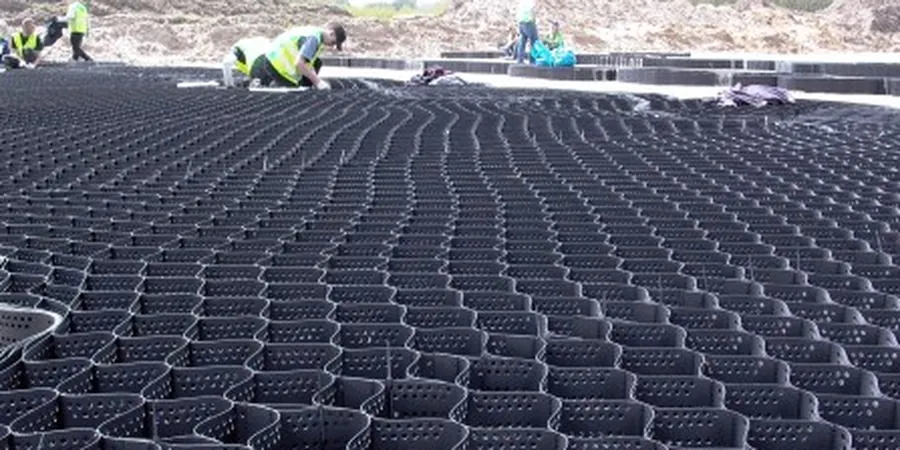
We start every geocell design in Houston by looking at the actual equipment available locally. The heavy-duty geocell panels are typically delivered on flatbed trucks, and we use a combination of tracked excavators and manual crews to lay them out on site. Houston's clay-rich soils, especially the Beaumont Formation, require careful consideration of moisture content before the infill material is placed. We often coordinate with the contractor's schedule to ensure the subgrade is at the right compaction level before the geocell goes down. This avoids the common problem of the panels shifting during installation, which can compromise the entire stabilization layer. A well-planned geocell design saves time and material costs from the start.
A geocell design that ignores Houston's clay shrink-swell behavior will fail within the first wet-dry cycle. Moisture control is everything.
Methodology and scope
In Houston, the biggest challenge we see is the shrink-swell behavior of the local clays. A geocell design here must account for volumetric changes that can crack pavements or destabilize slopes. We typically specify a perforated geocell to allow lateral drainage, combined with a non-woven geotextile separator below. The cell height and weld spacing are selected based on the expected traffic loads and the plasticity index of the subgrade. Before finalizing the design, we run a CBR test on the prepared subgrade to confirm the bearing capacity, and we also evaluate the expansive soil potential to determine if a lime treatment layer is needed beneath the geocell. These checks are standard for long-term performance in the Houston area.
Technical reference image — Houston
Local considerations
Houston grew rapidly after the 1960s, pushing development into low-lying prairie and former marshlands. The city's flat topography and high water table mean that any excavation quickly fills with groundwater. For geocell design, the main risk is not the load itself but the moisture trapped beneath the system. If the subgrade is not properly drained or if the geocell is placed directly on wet clay, the cells can deform and the infill can pump out under traffic. We have seen this happen on several haul roads near the Ship Channel. A drainage layer or a geocomposite strip drain is often the difference between a road that lasts five years and one that lasts fifteen.
Granular (sand, crushed stone) or local clay-sand mix
Subgrade CBR
≥ 2% for design; ≥ 5% recommended
Seam Strength (ASTM D4885)
≥ 800 lb/ft
UV Stabilization
2% carbon black minimum for exposed applications
Associated technical services
01
Road & Pavement Base Stabilization
Geocell design for unpaved access roads, temporary haul roads, and paved shoulders. We optimize cell geometry and infill to distribute loads over soft clay subgrades common in Harris County.
02
Slope & Channel Erosion Control
Reinforced geocell systems for 2:1 or steeper slopes along bayous and drainage channels. We include anchor pins and vegetation-friendly infill to meet Harris County Flood Control District standards.
03
Load Support for Storage Yards & Laydown Areas
Heavy-duty geocell design for industrial yards, container storage, and equipment staging. The system reduces aggregate thickness by 40% compared to unreinforced sections while preventing rutting in Houston's plastic clays.
What is the typical cost range for a geocell design study in Houston?
For a standard geocell design including site review and calculation report, the fee ranges between US$810 and US$2,670 depending on the area and complexity. A full design with drainage and subgrade analysis lands at the higher end.
Can geocell be used directly on Houston's expansive clay without a subgrade treatment?
Generally no. Unless the clay is at optimum moisture and well compacted, we recommend a 6-inch lime-stabilized working platform or a geotextile separator below the geocell. Swelling clay can lift the entire system if not addressed in the geocell design.
What infill material works best for geocell in Houston's humid climate?
Crushed limestone or recycled concrete aggregate (RCA) performs well because it drains and locks into the cells. Avoid using native clay as infill unless the cells are fully perforated and the slope is gentle. The infill must resist saturation from Houston's frequent rains.
How does geocell design interact with the city's drainage requirements?
Geocell systems are pervious by nature, so they help maintain infiltration rates required by the City of Houston's Storm Water Management Manual. We design the geocell with open cells or perforations to avoid creating an impervious layer that would increase runoff volume downstream.
Location and service area
We serve projects across Houston and its metropolitan area.