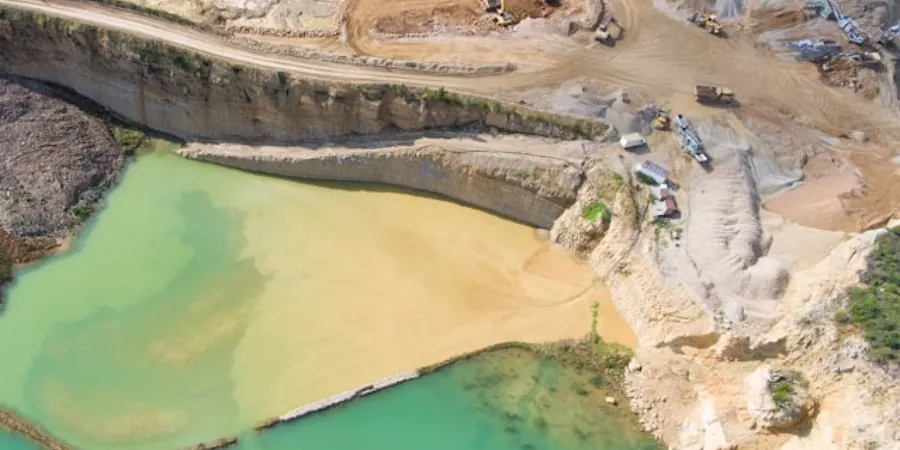
We were on a site near the Houston Ship Channel last year. The client planned a 15-story residential tower on what looked like uniform clay. After digging an exploratory test pit, we found a buried sand channel at 4 meters. That changed the foundation design completely. Houston's geology is deceptive. The city sits on thick Beaumont Clay, but old river channels and lenses of sand are common beneath the surface. An exploratory test pit lets us see the soil profile firsthand. It is the most direct method for identifying soft zones, fill layers, and groundwater seepage. Combined with capacity of load testing and borehole data, test pits give you the full picture before pouring concrete.
A test pit opens a trench wide enough to walk into. You see stratification, root cavities, and desiccation cracks that SPT samples miss entirely.
Methodology and scope
A common mistake we see in Houston is relying solely on boreholes. Drilling only samples a narrow column. A test pit opens a trench wide enough to walk into. You can see stratification, root cavities, and desiccation cracks that SPT samples miss entirely. The procedure follows ASTM D2488 for visual classification and ASTM D420 for subsurface exploration. We typically dig to 4.5 meters using a backhoe. The exposed face gets logged every 0.3 meters. Geotechnical parameters recorded include moisture content, color, consistency, and the presence of calcareous nodules. We also use the pit to install shallow groundwater monitoring wells. For highway and pipeline projects, we correlate the pit logs with geotechnical road design to evaluate subgrade support across long alignments. The pit is backfilled in lifts and compacted to 95% of standard Proctor density per ASTM D698.
Technical reference image — Houston
Local considerations
Houston's subtropical climate brings intense rainfall. Between April and October, the water table rises within 1.5 meters of the surface in many neighborhoods. If you dig a test pit during a dry spell and the water table is low, you might underestimate future groundwater pressures. The expansive Beaumont Clay shrinks and cracks in drought. Those cracks turn into preferential flow paths during wet months. A single test pit at the wrong time can give misleading data. We mitigate this by digging multiple pits across the site and correlating with long-term piezometer records. In flood-prone areas like the Buffalo Bayou corridor, we schedule test pits during the rainy season to capture worst-case conditions.
For single-family homes, townhouses, and low-rise buildings. We dig pits up to 3 meters to locate shallow foundations, verify fill thickness, and check for buried debris. Logs include soil color, plasticity, and moisture content per ASTM D2488.
02
Deep Utility & Pipeline Test Pits
For linear infrastructure projects. Pits reach 4.5 meters to expose existing utilities, verify pipe bedding, and assess trench stability. We measure in-situ density with sand cone tests (ASTM D1556) and record groundwater inflow rates.
What is the difference between a test pit and a borehole?
A test pit is a shallow excavation (up to 4.5 m) that exposes the soil profile visually. A borehole is a drilled hole that recovers disturbed or undisturbed samples. Test pits let you see stratification, root systems, and groundwater seepage directly. Boreholes are better for deep sampling beyond 5 meters.
How many test pits do I need for a typical Houston lot?
For a standard residential lot (0.25 acre), we recommend at least two pits. For commercial sites over 1 acre, we place pits every 100 to 150 feet along the building footprint. The number also depends on the variability of soils observed during digging.
How much does an exploratory test pit cost in Houston?
The typical range for a single test pit in Houston is US$540 - US$720. This includes mobilization, excavation, logging, backfill compaction, and a written field report. Costs can vary based on depth, number of pits, and site access conditions.
Can a test pit detect contaminated soil?
Yes. During logging we note odors, staining, and debris. If we suspect contamination (hydrocarbons, solvents, or buried waste), we stop digging and collect samples for laboratory analysis. The pit log includes field screening with a PID (photoionization detector) if requested.
Location and service area
We serve projects across Houston and its metropolitan area.