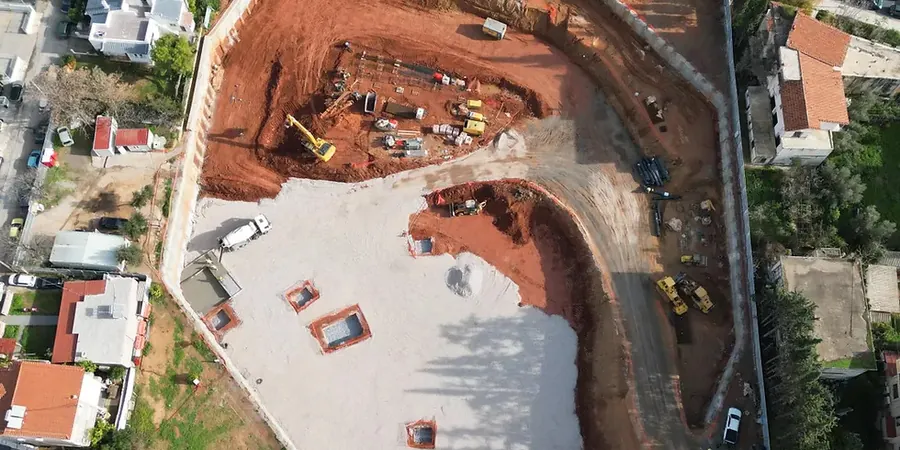
Sites near Buffalo Bayou in Houston present a very different soil profile than those on the west side around Katy. Downtown, you often hit stiff Beaumont clay within a few meters, while further west the profile shifts to interbedded sands and silty clays with higher groundwater. That contrast directly affects how we approach the geotechnical design of deep excavations in Houston. For a 15-meter basement in the central business district, we rely on effective stress analysis for clay behavior and check against undrained shear strength. On the sandy side, we bring in a study of liquefaction potential to assess cyclic softening in saturated layers, and for multi-tiered shoring we often run a numerical stability analysis to verify global factors of safety.
In Houston’s overconsolidated clays, undrained shear strength often governs bottom heave stability for excavations deeper than 12 meters.
Methodology and scope
A 12-story building with three basement levels near the Texas Medical Center required a 16-meter excavation through alternating clay and sand strata. The team installed inclinometers and piezometers before any bulk excavation began. For the geotechnical design of deep excavations in Houston, we always start with a detailed subsoil model based on SPT and CPT data. Design steps include: calculating lateral earth pressures using Rankine or Coulomb theory for temporary works, verifying bottom heave stability against the weight of the retained soil, and checking seepage gradients to prevent piping. We also incorporate the local groundwater monitoring data from the Harris-Galveston Subsidence District to model long-term drawdown effects and their impact on effective stress changes.
Technical reference image — Houston
Local considerations
The drill rigs we mobilize for this work carry continuous flight augers and hollow-stem tooling to retrieve undisturbed samples from depths exceeding 20 meters. In Houston, the biggest risk during deep excavations is rapid loss of confinement in the Beaumont clay if dewatering is mismanaged. The clay can develop tension cracks that propagate behind soldier piles, turning a stable wall into a progressive failure. We mitigate this by specifying filter drains behind the lagging and by monitoring pore pressure with vibrating-wire piezometers. Another common issue is the presence of buried sand channels from the Brazos River alluvial history, which can act as hidden conduits for water flow and cause sudden base instability.
Boreholes with continuous sampling to 25 m depth, Shelby tube sampling for undisturbed clay specimens, and CPT soundings for high-resolution stratigraphy.
02
Numerical Modeling of Shoring Systems
Finite element analysis using PLAXIS or FLAC to simulate soldier piles, secant piles, or diaphragm walls under staged excavation sequences.
03
Groundwater Control Design
Design of dewatering systems including wellpoints, deep wells, and cutoff walls to manage flow through interbedded sands and gravels.
04
Construction Monitoring & Instrumentation
Installation and real-time reading of inclinometers, piezometers, strain gauges, and settlement markers with automated alerts for threshold exceedance.
Applicable standards
ASCE 7-22 (minimum design loads including lateral earth pressures), IBC 2021 Chapter 18 (soils and foundations, excavation support), ASTM D1586-18 (standard penetration test for soil classification), FHWA-NHI-05-076 (structural and geotechnical design of earth retaining systems)
Frequently asked questions
What is the typical cost range for geotechnical design of deep excavations in Houston?
For a mid-size project in Houston, the engineering design and monitoring package typically falls between US$2,380 and US$9,060. The final figure depends on excavation depth, soil complexity, and whether instrumentation is included.
Do I need a dewatering permit for a basement excavation in the downtown area?
Yes. The Harris-Galveston Subsidence District requires a permit for any dewatering that exceeds 50,000 gallons per day. Our design always includes a water management plan that complies with local regulations.
What is the difference between soldier pile and secant pile walls for deep excavations?
Soldier piles with timber lagging are cost-effective for temporary excavations up to 12 m deep in stiff clay. Secant piles provide a watertight cutoff and are preferred for deeper cuts or where groundwater control is critical, such as near Buffalo Bayou.
How does the Beaumont clay affect bottom heave stability?
Beaumont clay is highly overconsolidated, with undrained shear strengths typically between 80 and 180 kPa. However, its high plasticity means that long-term drained conditions can reduce strength. We always check both short-term (undrained) and long-term (drained) factors of safety for basal heave.
Location and service area
We serve projects across Houston and its metropolitan area.