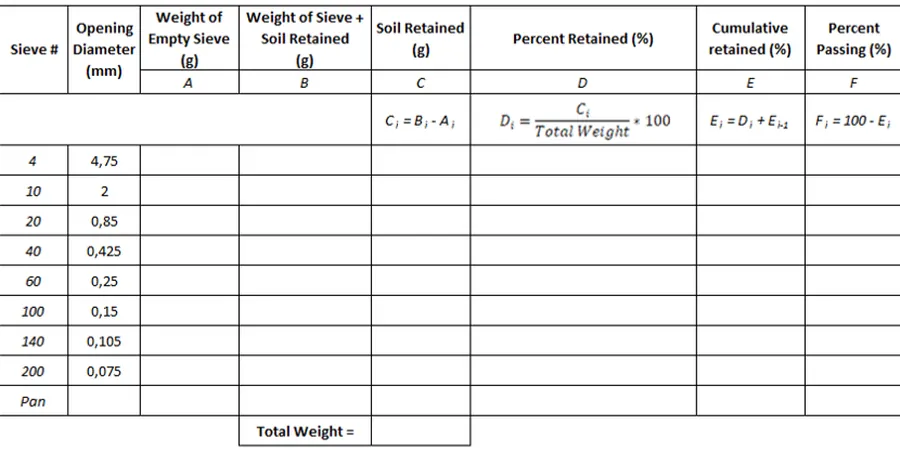
In Houston, the contrast between the Beaumont Formation clays in the south and the sandy terrace deposits of the north tells you everything about why grain size analysis matters. A foundation design for a townhouse in the Heights, where the soil is predominantly lean clay with silt lenses, calls for a completely different approach than a commercial slab in the Katy Prairie, where expansive clay dominates. We use sieve and hydrometer testing to quantify that difference, splitting the sample into fractions down to 0.001 mm, and we often pair it with Atterberg limits to understand plasticity and with a soil classification system like USCS to give the engineer a unified language for the ground conditions.
The fines fraction passing the No. 200 sieve in Houston floodplain deposits can exceed 85%, directly controlling the shrink-swell potential of the Beaumont Clay.
Methodology and scope
Houston sits on over 100 feet of Quaternary alluvium and coastal plain deposits, with the water table often sitting just 8 to 15 feet below grade. That means the fines content — the silt and clay passing the No. 200 sieve — can range from 40% in the upland areas to over 85% in the floodplain zones along Buffalo and White Oak Bayous. In our lab, we run the sieve portion following ASTM D6913, then transition to the hydrometer for particles finer than 75 microns, which is critical because those fines govern compressibility and shrink-swell behavior. We also cross-reference the distribution curve with the consolidation potential of the soil, especially for sites near the Ship Channel where deeper clay layers can show preconsolidation from past desiccation.
Technical reference image — Houston
Local considerations
Houston's population has grown by nearly 20% since 2010, pushing development into former rice fields and marshland where the natural soil structure is weak. In those areas, a grain size analysis that misses the fines content by even 5% can lead to an underestimation of the shrink-swell index, and we have seen slab foundations crack within two years because the design assumed a sandier profile than what actually exists. That is why we always run the full hydrometer curve on the passing fraction — the clay platelets in the Beaumont Formation can cause differential heave that no settlement calculation will catch if the fines are misclassified.
Grain size distribution curve, D10, D30, D60, Cu, Cc
Associated technical services
01
Full Sieve + Hydrometer Analysis
Complete gradation curve from 75 mm down to 0.001 mm, including both dry and wet sieving plus sedimentation. Suitable for clays, silts, sands, and gravelly soils found in Houston's diverse geology.
02
Washed Sieve Analysis (No. 200 Fines Determination)
Targeted test for measuring the percentage passing the No. 200 sieve, with washing to remove clay coatings. Often used as a preliminary screening before hydrometer testing on high-fines soils.
03
Hydrometer Analysis (Sedimentation Method)
Detailed measurement of particles finer than 75 microns using the Bouyoucos hydrometer method. Critical for characterizing the clay fraction in Beaumont and Montgomery formations.
04
Combined Gradation with USCS Classification
Full sieve and hydrometer curve plus a final USCS or AASHTO classification. Includes D10, D30, D60, coefficient of uniformity (Cu), and coefficient of curvature (Cc) for engineering use.
Applicable standards
ASTM D6913-17 (Standard Test Methods for Particle-Size Distribution of Soils Using Sieve Analysis), ASTM D7928-21 (Standard Test Method for Particle-Size Distribution of Soils Using Hydrometer), ASTM D2487-17 (Standard Practice for Classification of Soils for Engineering Purposes - USCS), AASHTO T-88 (Particle Size Analysis of Soils)
Frequently asked questions
How much does a grain size analysis (sieve + hydrometer) cost in Houston?
The typical cost for a combined sieve and hydrometer analysis in Houston ranges from US$90 to US$190 per sample, depending on whether you need both wet and dry sieving, and whether the hydrometer curve must run for the full 24-hour sedimentation period. Large projects with volume discounts may see lower per-sample pricing.
Why is hydrometer analysis necessary for Houston soils?
Houston's dominant clay soils — the Beaumont and Montgomery formations — contain a high percentage of particles smaller than 75 microns. A standard sieve alone cannot distinguish between silt and clay; the hydrometer uses Stokes' law to separate the fine fractions. Without it, you risk misclassifying an expansive clay as low-plasticity silt, which directly affects slab and foundation design.
How long does a grain size analysis take from sampling to report?
A standard sieve analysis can be completed within 1 to 2 business days. Adding the hydrometer sedimentation test extends the timeline to 3 to 5 business days, because the sample must settle undisturbed for up to 24 hours to capture the finest clay particles. We can expedite the process for critical path projects.
Do you provide grain size data suitable for USCS classification?
Yes, every grain size analysis we run includes the full distribution curve with D10, D30, D60, Cu, and Cc values. We also provide a USCS classification (ASTM D2487) and can cross-reference with AASHTO M 145 if needed. The report includes the percent gravel, sand, silt, and clay, so the engineer can classify the soil without additional testing.
Location and service area
We serve projects across Houston and its metropolitan area.