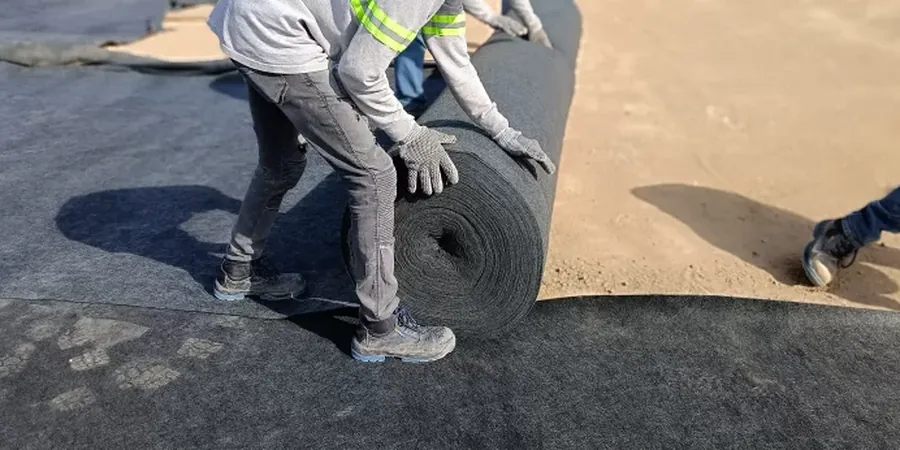
The difference between building on the Beaumont Formation clay near Memorial Park versus the alluvial sands along the Buffalo Bayou corridor is night and day. In Houston, the upper clay crust can support moderate loads, but the underlying Beaumont clay exhibits high plasticity and shrink-swell potential. That is why geogrid specification must account for the specific soil profile at each site. We have seen projects in the Energy Corridor where a uniaxial geogrid was the only solution to prevent lateral spreading under embankment loads. Conversely, subdivisions in Katy often require biaxial geogrids for subgrade stabilization before placing base course. Before writing a specification, we always review the ensayo-proctor results to confirm compaction targets, and we cross-reference the corte-directo shear strength parameters to match the geogrid tensile capacity with the mobilized soil resistance.
Houston clay with PI above 50 requires geogrid aperture stability verification; junction efficiency is not optional for long-term performance.
Methodology and scope
Around Houston, many engineers assume a standard biaxial geogrid works everywhere. That is a mistake. The clay in the Greater Houston area can have a plasticity index above 50, which means the geogrid must be specified with adequate aperture stability to prevent the clay from punching through. Our team follows ASTM D6637 for tensile testing and ASTM D4759 for installation damage reduction factors.
Uniaxial geogrids for reinforced soil slopes and retaining walls where tensile strength along one axis is critical
Biaxial geogrids for subgrade stabilization under paved and unpaved roads
Triaxial geogrids for multi-directional load distribution in soft subgrades
Each type requires a specific junction efficiency and long-term design strength. We also consider the site's groundwater level, because a high water table can reduce geogrid-soil interlock. For projects near the Houston Ship Channel, we often recommend a geocomposite that combines drainage with reinforcement.
Technical reference image — Houston
Local considerations
Houston's humid subtropical climate and expansive clay create a dual risk for geogrid performance. First, seasonal moisture cycles cause the clay to swell and shrink, which imposes cyclic tensile strains on the geogrid. Second, the high water table after heavy rainfall, typical during hurricane season, can reduce soil-geogrid interlock by increasing pore water pressure. If the geogrid is not specified with adequate chemical resistance for the alkaline clay environment, hydrolysis can degrade the polymer over time. These conditions demand a specification that includes partial factors for installation damage and creep, as outlined by FHWA guidelines.
Reduced by creep, installation damage, and chemical degradation
Roll dimensions
3.8 m x 50 m to 6 m x 50 m
UV resistance (500 hours)
≥70% retained strength per ASTM D4355
Associated technical services
01
Geogrid selection for subgrade stabilization
Biaxial and triaxial geogrids for paved and unpaved roads, parking lots, and working platforms. We calculate the required tensile strength using the Boussinesq-based method and verify against site CBR values.
02
Geogrid specification for reinforced slopes and walls
Uniaxial geogrids for mechanically stabilized earth (MSE) walls and reinforced soil slopes. We determine the vertical spacing, embedment length, and connection details per AASHTO LRFD.
Applicable standards
ASTM D6637 (Tensile properties of geogrids), AASHTO M288 (Geotextile specification, referenced for geogrid selection), GRI-GG2 (Standard test method for junction strength), ASTM D5262 (Tensile creep and creep-rupture behavior)
Frequently asked questions
What is the difference between uniaxial and biaxial geogrids for Houston soils?
Uniaxial geogrids have high tensile strength in one direction, used for MSE walls and steep slopes. Biaxial geogrids have balanced strength in both directions, ideal for subgrade stabilization under roads. In Houston clay, biaxial grids with aperture sizes between 25 mm and 33 mm work best to prevent soil intrusion.
How does Houston expansive clay affect geogrid long-term performance?
Expansive clay cycles between wet and dry states, imposing repeated tensile strains on the geogrid. This can cause creep and fatigue over time. We specify a creep reduction factor of at least 2.5 per GRI-GG4 for projects in the Beaumont formation. The geogrid must also resist alkaline hydrolysis typical of Houston clay.
What is the typical cost range for a geogrid specification study in Houston?
The cost for a geogrid specification study including soil testing and report ranges between US$400 and US$1.240 depending on the number of geogrid types evaluated and whether pullout tests are required. This covers material selection, reinforcement design, and installation guidelines.
Do I need a geogrid specification if I am building on sandy soil near the coast?
Yes. Sandy soils in areas like Clear Lake or Galveston Bay lack cohesion and can liquefy under dynamic loads. A geogrid specification for sand includes selecting an open aperture grid that interlocks with the particles, and verifying that the grid's tensile strength can resist differential settlement. We always run a sieve analysis first.
Location and service area
We serve projects across Houston and its metropolitan area.