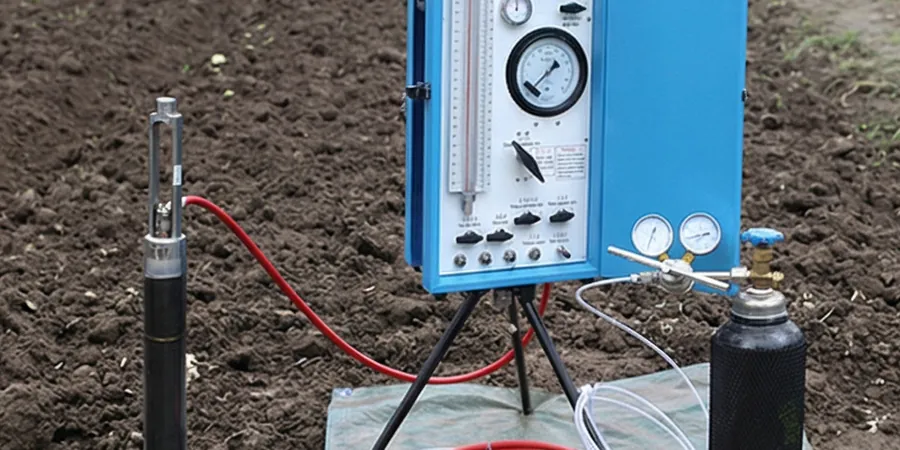
Houston sits on a thick sequence of Beaumont and Lissie clays, with interbedded sand layers that shift laterally within meters. The water table sits shallow—typically 3 to 6 m deep—and the clays are highly plastic, with LL often above 60. That combination makes conventional SPT alone unreliable for modulus and settlement estimates. In our experience, the Ménard pressuremeter test (PMT) gives the most direct measurement of deformation modulus and limit pressure in these soils. Before designing deep foundations, we always recommend correlating PMT results with piles load tests to calibrate the design parameters for Houston's variable alluvium.
In Beaumont clay, PMT limit pressures of 0.8–1.6 MPa directly govern bearing capacity for shallow footings and pile shaft resistance.
Methodology and scope
Houston covers about 1,700 km² and sits at an average elevation of only 13 m above sea level. The flat coastal plain means drainage is poor and the clays stay saturated year-round. We run the PMT according to ASTM D4719, using a 60 mm probe inflated in 13 equal-volume increments. The test gives us two key parameters: the Menard modulus (EM) and the limit pressure (pL). In the stiff Beaumont clay, EM values range from 8 to 14 MPa, while pL sits between 0.8 and 1.6 MPa. When we find loose sand lenses, EM drops to 3–5 MPa. We cross-check those results with a veleta de campo to confirm undrained shear strength in the same borehole.
Technical reference image — Houston
Local considerations
Houston's rapid urban expansion since the 1970s pushed development onto former rice fields and wetlands. Those areas have soft, compressible clays up to 12 m thick. Without PMT data, many foundations were over-designed or, worse, settled unevenly. In our work around the Katy Prairie and the Energy Corridor, we've seen PMT identify soft zones that SPT missed entirely. The test also captures the stress-strain behavior under real loading, not just blow counts. Skipping the PMT in these settings means gambling on differential settlements of 5 cm or more in slab-on-grade construction.
Borehole pressuremeter tests at 1.5 m intervals down to 30 m. We report EM, pL, and creep pressure for each depth, plus interpreted bearing capacity and settlement curves per IBC Chapter 18.
02
PMT for Slope & Excavation Design
Focused testing along cut slopes and excavation walls to measure horizontal modulus and limit pressure. Used to design temporary shoring and permanent MSE walls in Houston's clay formations.
Applicable standards
ASTM D4719 (Standard Test Method for Menard Pressuremeter Testing), ASCE 7 (Minimum Design Loads for Buildings), IBC 2021 (International Building Code, Chapter 18)
Frequently asked questions
How does PMT differ from SPT in Houston clays?
SPT gives blow counts that correlate roughly to strength, but PMT measures the actual stress-strain curve. In Beaumont clay, SPT N-values of 15–25 can correspond to PMT limit pressures ranging from 0.8 to 1.6 MPa. The PMT directly yields the deformation modulus needed for settlement analysis, while SPT only provides a qualitative index.
What is the typical cost range for a Ménard pressuremeter test in Houston?
The cost for a single PMT test point, including mobilisation and report, ranges from US$980 to US$1,080. Volume discounts apply when testing 6 or more points on the same site.
At what depth should PMT be performed for a 3-story building on slab?
We recommend PMT every 1.5 m from 1.5 m down to 6 m, plus one test at 9 m to confirm no deeper soft layers. For Houston's Beaumont formation, the critical zone is 3–6 m where the stiff crust transitions to softer clay.
Can PMT be used in sandy layers found in Houston?
Yes, the Ménard pressuremeter works well in sands, provided the borehole is stable. In loose sand lenses (EM under 5 MPa), we use a pre-drilled casing to prevent collapse. The test gives reliable modulus values that SPT cannot match for settlement predictions.
How long does it take to complete a PMT profile on a typical lot?
A full profile of 6 test points down to 9 m takes about 4–5 hours on site. We set up the probe, drill the borehole, and run the incremental loading. The report with all curves and interpreted parameters is delivered within 3 business days.
Location and service area
We serve projects across Houston and its metropolitan area.