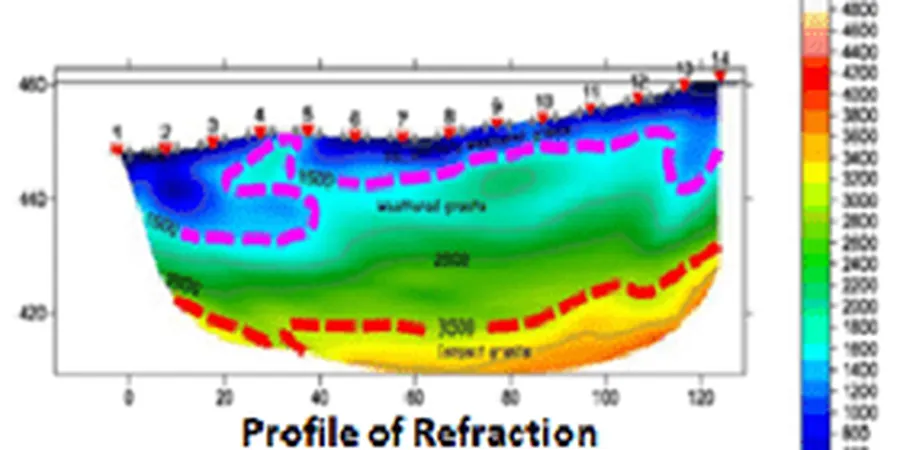
Houston sits on thick Quaternary alluvium and coastal plain deposits, with the Beaumont Clay layer extending over 30 meters in many areas. This soft, high-plasticity clay overlies older Tertiary formations at varying depths, creating a challenging environment for deep foundations. Seismic tomography (refraction/reflection) provides a continuous velocity profile through these layers, identifying the top of the harder Fleming Formation or the Yegua Sandstone. The method uses surface-generated P-waves and S-waves, with 24- to 48-channel arrays and 4.5 Hz geophones, to map velocity contrasts down to 60 meters. In Houston, where the water table sits only 1.5 to 3 meters below grade, refraction surveys capture the saturated zone velocity accurately, while reflection components resolve deeper stratigraphic boundaries. The resulting 2D velocity model guides decisions on pile embedment depths and helps identify potential cimentaciones sísmicas issues in the region's moderate seismic zone.
In Houston, seismic tomography reveals the buried topography of the Fleming Formation, critical for designing deep foundations that bypass the weak Beaumont Clay.
Methodology and scope
Field crews in Houston often set up 200 to 400 meter profiles along the Buffalo Bayou corridor or near the Ship Channel to capture lateral variability. The survey generates compressional and shear wave velocity (Vp and Vs) sections at 2 to 5 meter vertical resolution. Key parameters include:
P-wave velocity range: 300 m/s (soft clay) to 2,500 m/s (dense sand/gravel)
S-wave velocity range: 100 m/s to 800 m/s
Array spacing: 2 to 5 meters between geophones
Source: 8 kg sledgehammer or accelerated weight drop
Data processing follows ASTM D4428/D4428M standard for seismic refraction, with refraction tomography inversion using first-arrival picks. Reflection processing includes bandpass filtering, gain correction, and migration for structural interpretation. The combined refraction/reflection dataset produces a unified velocity model that correlates well with borehole logs from nearby ensayo SPT soundings, especially in the transition from Beaumont Clay to the underlying Lissie Formation.
Technical reference image — Houston
Local considerations
The difference between the western and eastern sides of Houston can be stark. West of downtown, the Beaumont Clay is often thinner, with the Fleming Formation appearing at 20 to 25 meters. East toward Baytown, the same formation may drop below 40 meters, requiring deeper pile foundations. Seismic tomography identifies these lateral changes efficiently, avoiding the cost of multiple deep boreholes. Without this velocity model, foundation design may underestimate the depth to bearing strata, leading to excessive settlements or the need for costly pile extensions. In areas like the Energy Corridor, where heavy industrial loads are common, this data is essential for verifying site class per ASCE 7.
High-resolution 2D velocity models of the upper 40 meters using first-arrival traveltime inversion. Ideal for locating the top of the Fleming Formation and assessing excavation conditions for deep basements or bridge piers.
02
Reflection Tomography for Deep Structure
Common-depth-point (CDP) reflection processing for imaging deeper stratigraphic boundaries between 30 and 60 meters. Resolves fault offsets or channel scours that affect pile installation in the Houston Ship Channel area.
03
Combined Refraction/Reflection for Vs30
Integrated velocity model from surface to 30 meters depth for calculating Vs30 per ASCE 7-22. Used for seismic site classification of schools, hospitals, and critical facilities in Harris County.
Applicable standards
ASTM D4428/D4428M - Standard Test Methods for Crosshole Seismic Testing, ASTM D5777 - Standard Guide for Using the Seismic Refraction Method for Subsurface Investigation, ASCE 7-22 Section 11.4 - Site Class Determination Using Vs30
Frequently asked questions
What is the typical depth range of seismic tomography in Houston?
In Houston, seismic refraction and reflection surveys commonly reach 30 to 60 meters depth, depending on source energy and array length. The method is most effective down to the top of the Fleming Formation, typically at 20 to 40 meters.
How does seismic tomography compare to standard SPT borings?
Seismic tomography provides continuous 2D velocity profiles across a profile line, while SPT borings give point-specific blow counts. The two methods are complementary: tomography maps lateral variability, and SPT borings confirm soil type and strength at discrete depths.
What is the cost range for a seismic tomography survey in Houston?
The cost for a typical 200 to 400 meter survey in Houston ranges between US$3,050 and US$5,960, depending on array length, number of source points, and data processing requirements. This includes field acquisition, data inversion, and a report with velocity sections.
Location and service area
We serve projects across Houston and its metropolitan area.