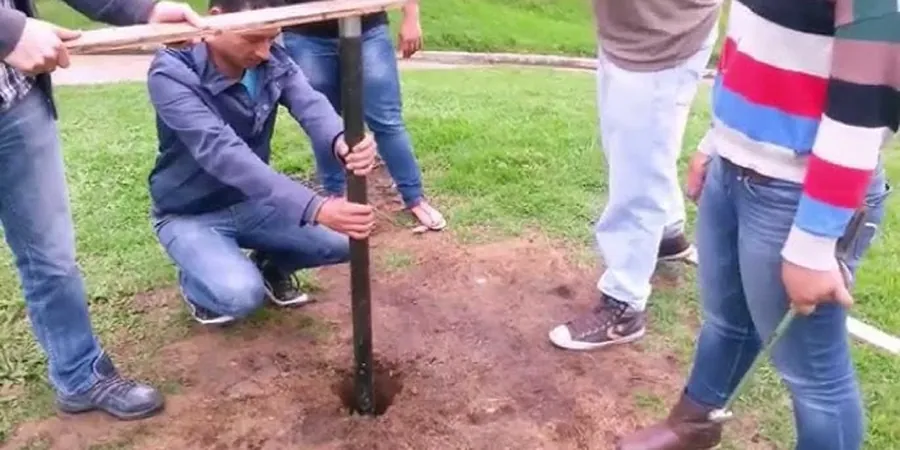
Houston sits on the Beaumont Formation, a thick sequence of high-plasticity clays and silty clays that extend tens of meters deep. These expansive soils present a unique challenge: their undrained shear strength can vary dramatically with depth and moisture content. A field vane shear test (VST) is the most reliable method to measure this parameter directly in situ without disturbing the sensitive clay structure. Before designing foundations for any structure in Houston, knowing the peak and residual shear strength profiles is essential to avoid overestimating bearing capacity. This is why our team deploys the VST routinely alongside a classification of soils to correlate vane results with index properties, and a plate load test when verifying shallow foundation performance on stiff clays.
In Beaumont clays, the remolded-to-peak strength ratio can drop below 0.25, a sign of high sensitivity that demands careful foundation design.
Methodology and scope
Our field vane equipment includes a torque head with calibrated springs ranging from 20 N·m to 200 N·m, four-blade stainless steel vanes in standard B sizes (H=2D, blade height 75 mm to 130 mm), and a set of extension rods for depths up to 30 m. The test procedure follows ASTM D2573-19 strictly. We advance a borehole to the target depth, push the vane 450 mm into undisturbed soil, then rotate at a constant rate of 6°/min. The peak torque is recorded, followed by the remolded torque after 10 full rotations. The undrained shear strength is calculated as Su = T / K, where K is the vane constant. In Houston, the ratio of remolded to peak Su often falls below 0.25 in Beaumont clays, indicating high sensitivity. We complement this data with a consolidation test on undisturbed samples to evaluate settlement behavior under long-term loads.
Technical reference image — Houston
Local considerations
Consider a 10-story mixed-use building planned near Buffalo Bayou, where the top 6 m consist of highly plastic clay. Without a field vane shear test, the designer assumed a uniform Su of 50 kPa across the entire layer. The VST revealed Su values dropping to 18 kPa between 3 m and 4.5 m depth, with a sensitivity of 6. That zone alone controlled the foundation depth, requiring piles to extend 2 m deeper into stiffer clay. Skipping the in-situ vane test would have led to differential settlements exceeding 50 mm, cracking the first-floor slab within two years.
Undrained shear strength (Su) = T / K, where K = π D² H (1 + D/3H)
Associated technical services
01
Standard VST for Preliminary Geotechnical Investigation
Includes a single borehole advanced to 15 m depth, with VST readings every 1.5 m in clay layers. Typical for residential subdivisions, low-rise commercial, and pavement subgrade assessments. Report includes Su profile, sensitivity values, and correlation with natural water content.
02
Advanced VST with Continuous Profiling
For high-risk projects such as high-rise towers, deep excavations, or levees. Combines VST with CPTU soundings every 0.5 m to create a continuous strength profile. Includes remolded strength testing at critical depths and a detailed sensitivity analysis for dynamic loading scenarios like hurricane surge.
Applicable standards
ASTM D2573-19 (Standard Test Method for Field Vane Shear Test in Saturated Fine-Grained Soils), ASTM D2487-17 (Standard Practice for Classification of Soils for Engineering Purposes), IBC 2021 Chapter 18 (Soils and Foundations)
Frequently asked questions
How is the field vane shear test different from a lab unconfined compression test?
The VST measures undrained shear strength in situ, preserving the natural stress state, fabric, and moisture content of the clay. Lab tests on undisturbed samples inevitably suffer from stress relief and sample disturbance, especially in sensitive Houston clays. The VST gives a more representative value for short-term stability analyses.
What is the typical cost range for a field vane shear test in Houston?
For a standard VST program with one borehole and readings every 1.5 m to 15 m depth, expect costs between US$670 and US$1,310. Factors like mobilization distance, number of test depths, and site access (e.g., confined urban lots vs. open fields) affect the final quote.
Can the VST be performed in any type of soil?
No, the VST is specifically designed for saturated fine-grained soils—clays and silty clays—with undrained shear strengths typically below 200 kPa. In sands, gravels, or stiff overconsolidated clays, the vane may not penetrate or the torque may exceed equipment limits. For those soils, a cone penetration test or SPT is more appropriate.
How does the VST data influence foundation design in Houston's Beaumont clay?
The VST provides peak and remolded undrained shear strength profiles, which directly determine the short-term bearing capacity of shallow foundations and the skin friction of piles. In highly sensitive clays (sensitivity >4), the remolded strength governs the factor of safety against progressive failure. Designers use the Su profile to optimize foundation depth and avoid over-designing for strength that doesn't exist at depth.
Location and service area
We serve projects across Houston and its metropolitan area.