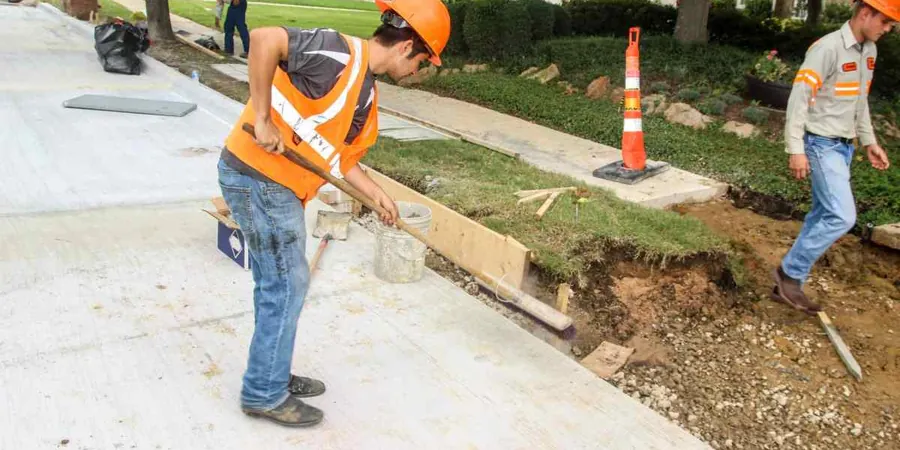
Houston's soil profile is no joke. In the Heights, you'll find stiff clays that hold up reasonably well. Head west toward Katy, and you're dealing with deep alluvial deposits that shift with every rain event. That contrast makes rigid pavement design a task that demands local knowledge. We see projects where a standard slab on grade would crack within two years because the subgrade wasn't evaluated properly. That's why we start every Houston pavement project with a thorough site investigation, combining subgrade testing with CBR values to understand bearing capacity before we even talk about concrete thickness.
Houston's expansive clays can swell 15% in volume — that movement determines joint spacing, reinforcement, and concrete thickness directly.
Methodology and scope
Houston sits at roughly 50 feet above sea level, but the real story is underground. The city's expansive clays can swell up to 15% in volume when wet, then shrink just as fast during dry spells. That movement is the number one cause of rigid pavement failure in this region. Our approach involves measuring soil plasticity through Atterberg limits to classify shrink-swell potential, then designing joint spacing and reinforcement accordingly. We also model traffic loads using TxDOT's FPS 21 software, factoring in the high truck volume on roads like I-45 or the Sam Houston Tollway. The result is a pavement that handles both the clay movement and the heavy loads without premature cracking.
Technical reference image — Houston
Local considerations
The biggest risk in Houston rigid pavement design comes from differential movement. When one section of clay dries out faster than the adjacent area, the slab loses support and cracks. We've seen this on residential streets in Bellaire and on industrial yards near the Ship Channel. To mitigate it, we run infiltration tests at multiple points across the site to map moisture variability. Then we design a stabilized subgrade layer — usually 8 inches of lime-treated clay — to buffer the slab from those localized changes. Without that buffer, even a well-designed 10-inch slab can fail within five years.
We drill test pits and take Shelby tube samples to classify the clay profile, then recommend lime or cement treatment to reduce plasticity. For Houston's high-PI clays, we typically target a PI reduction of at least 15 points before placing the slab.
02
Concrete mix and thickness design
Using flexural strength (MR) targets between 550 and 650 psi, we calculate slab thickness based on traffic loads and subgrade support. We also specify dowel bars at transverse joints and tie bars at longitudinal joints to control cracking.
03
Joint layout and drainage planning
We design contraction joints at 12- to 15-foot spacing to match the clay's natural shrinkage pattern. Proper subdrainage is critical in Houston, so we include edge drains and a permeable base layer to prevent water buildup under the slab.
Applicable standards
AASHTO Guide for Design of Pavement Structures (1993), TxDOT Pavement Design Manual (Chapter 3, Rigid Pavement), ASTM D4318 (Atterberg Limits for shrink-swell classification), ASTM D1196 (Nonrepetitive Static Plate Load Test for k-value)
Frequently asked questions
What makes rigid pavement design different in Houston compared to other cities?
Houston's expansive clay soils have a plasticity index that can exceed 50, which is much higher than what you'd find in, say, Denver or Phoenix. That high shrink-swell potential means joint spacing has to be tighter, and a stabilized subgrade is almost always necessary to prevent differential movement. We also have to account for the area's high water table — in some parts of town, groundwater sits just 5 feet below the surface.
How much does a rigid pavement design study typically cost in Houston?
For a standard project, the geotechnical investigation and structural pavement design typically ranges between US$2,070 and US$5,850. The final cost depends on the number of test locations, the lab testing required, and the complexity of the traffic loading. We provide a detailed scope and quote after reviewing the site conditions.
Do you follow TxDOT standards or AASHTO for rigid pavement design?
We use both. The AASHTO 1993 Guide provides the structural number and thickness calculations, while TxDOT's FPS 21 software refines those numbers for Texas-specific materials and climate. For Houston projects, we also reference the Houston District supplemental specifications on subgrade treatment and joint sealing.
Location and service area
We serve projects across Houston and its metropolitan area.