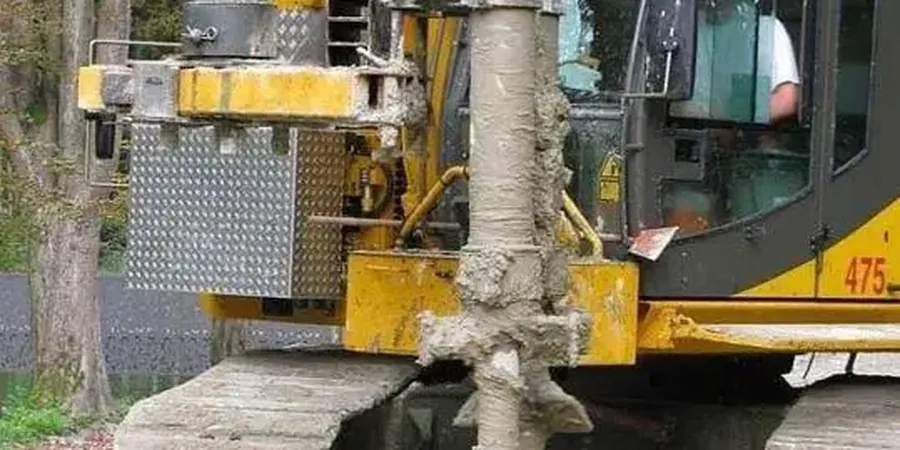
Houston sits on a thick layer of Beaumont Clay, a highly plastic deposit that expands and contracts with moisture. The city's high water table and flat topography create tricky conditions for any deep foundation. When you need to improve weak soil to support heavy loads, deep soil mixing (DSM) design becomes a go-to method. We've seen this technique work well in Houston's soft clays, where a cementitious binder is mechanically blended with the in-situ soil to form columns of stronger, stiffer ground. Before DSM, we often run a resistivity survey to map soil variability across the site and a plate load test to confirm the improved soil's modulus. Both help tailor the binder mix design to local conditions.
The Beaumont Clay's natural water content between 25% and 40% demands a binder mix tailored to each specific site, not a generic recipe.
Methodology and scope
What sets our DSM design approach apart in Houston is the integration of real local data. We don't just pull parameters from textbooks. The Beaumont Clay here has a natural water content between 25% and 40%, and its undrained shear strength can range from 10 kPa near the surface to over 80 kPa at depth. For DSM design, we correlate these with the target unconfined compressive strength of the treated soil, typically aiming for 0.5 to 2.0 MPa depending on the load. We also account for the organic content found in some of the old river terrace deposits. In our experience, the most common mistake is oversimplifying the binder dosage. We perform laboratory mix trials on actual Houston soil samples before finalizing the wet or dry method. The design must also consider the liquefaction potential of loose sand lenses that can be present in the alluvial layers below the clay.
Technical reference image — Houston
Local considerations
The DSM rigs we deploy in Houston are heavy crawler-mounted units that can exert 300 kN of torque. They work by rotating a mixing tool into the ground while injecting the binder slurry. The biggest risk on a Houston site is encountering a buried utility or old foundation that isn't on any map. We always require a utility clearance and a geophysical survey before mobilizing. Another risk is the binder slurry setting too fast if the water table is low during a drought. We adjust the retarder dosage in the mix to account for seasonal variations in groundwater chemistry. We also monitor spoil volume closely — excessive spoil can indicate the soil is being over-cut, which wastes binder and reduces strength.
Design of soil-mixed columns to support spread footings and mat foundations in soft clay. Includes block and panel layouts optimized for the Beaumont Clay's variable strength. We run laboratory mix trials to determine the exact binder content needed for each target strength.
02
DSM for Excavation Support and Cutoff Walls
Design of overlapping DSM columns to form seepage cutoff walls and temporary excavation shoring. Particularly useful in Houston's high water table where sheet piling alone may not be watertight. We integrate hydraulic conductivity targets (k < 1x10⁻⁷ m/s) into the mix design.
Applicable standards
ASCE 7, IBC 2021, ASTM D1633 (unconfined compressive strength of treated soil), FHWA-HRT-17-057 (Deep Mixing for Embankment Support)
Frequently asked questions
How much does a deep soil mixing design in Houston cost?
The cost for a deep soil mixing design in Houston typically ranges between US$1,560 and US$7,220. This covers laboratory mix trials, column layout design, and a final report with strength verification. The price depends on the number of columns and the complexity of the soil profile.
What soil conditions make DSM necessary in Houston?
Deep soil mixing is most needed in Houston when you encounter thick deposits of soft Beaumont Clay with low bearing capacity, or when loose sand lenses below the water table pose liquefaction risk. DSM improves both strength and stiffness of the native soil, reducing settlement under structural loads. It is also used to create vertical barriers in high-permeability zones.
How long does the DSM design process take?
The design process usually takes 2 to 4 weeks from the time we receive undisturbed soil samples. The first week is for laboratory mix trials to determine the optimum binder type and dosage. The second week involves numerical modeling of the column layout and settlement analysis. A final review with the structural engineer follows.
Location and service area
We serve projects across Houston and its metropolitan area.