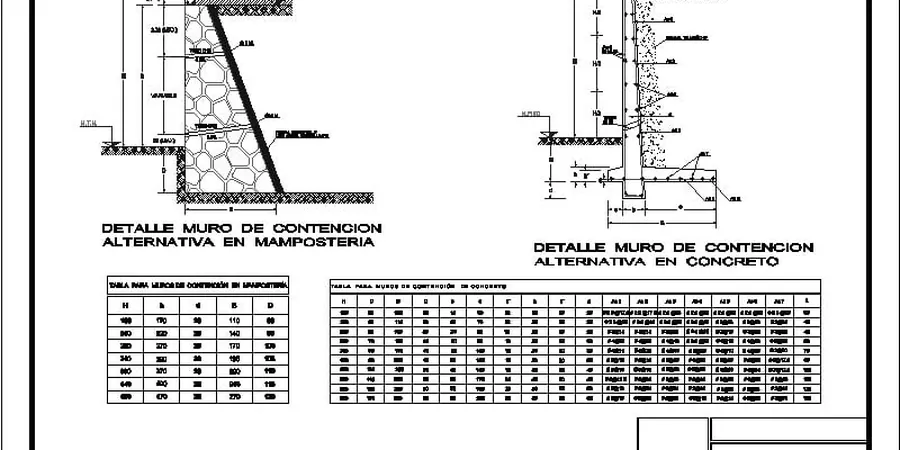
Houston sits on deep Beaumont clay formations that shrink and swell with seasonal moisture. Expansive soils here can push lateral earth pressures well above textbook values, especially near bayous like Buffalo Bayou or along the Katy Prairie. For any cut deeper than 4 feet in this city, we run at least two consolidated undrained triaxial tests to get realistic shear strength parameters. Before finalizing a retaining wall design in Houston, we recommend pairing those results with a plate load test at the base elevation to confirm the subgrade reaction modulus. That combination avoids surprises during excavation.
Houston clay can double lateral pressure after heavy rain. A drained analysis alone is not safe for this geology.
Methodology and scope
A common mistake we see locally is assuming drained conditions for clays that haven't fully consolidated. In Houston's high-plasticity clays, undrained loading governs short-term stability. Our retaining wall design in Houston always includes both short-term and long-term analyses because the difference can shift the required embedment depth by 30 percent. We follow AASHTO LRFD for the structural side and IBC 2021 for seismic loads, even though Houston is in Seismic Design Category B. The approach includes:
SLIDE and FLAC slope models for global stability
Broms method for cantilever walls in clay
At-rest pressure coefficients for braced excavations near existing utilities
Integrating suelos expansivos data early in the design prevents heave-related cracking behind the wall face.
Technical reference image — Houston
Local considerations
Compare the soil east of downtown near the Ship Channel with the ground in Sugar Land or Missouri City. The channel area has interbedded sands and stiff clays that drain fast, while Sugar Land's Beaumont clay can retain water for weeks after heavy rain. That difference matters for retaining wall design in Houston because pore pressure buildup reduces effective stress and triggers sliding. In the Energy Corridor, old terrace deposits and fill layers create variable conditions within the same block. Without site-specific data, you risk a wall that works in one zone but fails in another.
Direct shear and CU triaxial tests on undisturbed samples taken from the wall alignment. We run at least three tests per soil layer to define the Mohr-Coulomb envelope. Results are delivered with both peak and residual strengths, critical for long-term performance in Houston's clay.
02
Slope Stability & Global Factor of Safety
Using SLIDE 9.0 and FLAC 8.1, we model circular and non-circular failure surfaces. For walls taller than 12 feet, we include pseudo-static seismic coefficients per IBC 2021. The output gives a clear factor of safety for each potential slide plane.
How deep should a retaining wall be embedded in Houston clay?
For cantilever walls in stiff to very stiff clay, we recommend an embedment depth of at least 1.5 times the exposed height. In soft or medium clays, that increases to 2.0 times. The exact value depends on the undrained shear strength from triaxial tests.
What lateral earth pressure do you use for retaining wall design in Houston?
We use at-rest pressure coefficients (Ko = 0.6–0.8) for braced walls and active coefficients (Ka = 0.35–0.50) for free-standing cantilever walls. For walls retaining expansive clay, we add a surcharge of 200 psf equivalent to account for swelling pressure.
How much does a retaining wall geotechnical design cost in Houston?
The geotechnical investigation for retaining wall design in Houston typically ranges between US$980 and US$4,560, depending on wall length, required borings, and laboratory tests. A standard 50-foot wall with three borings and triaxial tests falls near the middle of that range.
Do I need a drainage system behind the wall?
Yes, absolutely. Houston's clay can hold water for weeks. We design vertical strip drains or a gravel blanket with a perforated pipe at the base. Without drainage, hydrostatic pressure behind the wall can double the lateral load and cause failure.
What is the difference between MSE walls and cantilever walls for Houston soils?
MSE (mechanically stabilized earth) walls work well for heights above 20 feet and allow for differential settlement in soft clay. Cantilever walls are more rigid and suited for shorter heights and sites with better bearing capacity. For Houston's expansive clay, MSE walls often perform better because they flex without cracking.
Location and service area
We serve projects across Houston and its metropolitan area.