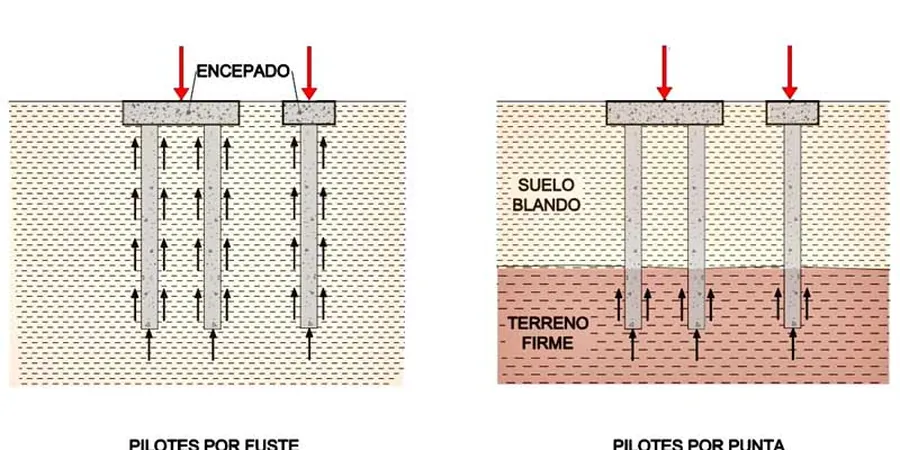
Houston's thick clay layers and deep sand strata make pile design a matter of balancing skin friction against end bearing. In our experience, the Beaumont Clay formation often governs shaft resistance, while the deeper sands of the Willis Formation provide the tip capacity. Getting this balance wrong leads to overdesign or settlement issues. We combine site-specific borings with advanced lab testing to quantify both components. A common starting point is the ensayo SPT to correlate blow counts with unit shaft resistance, but we also rely on CPT data for continuous profiles. The key is recognizing that Houston clays exhibit high undrained shear strength near the surface but lose it with depth, while the sands gain friction angle steadily. That contrast defines how we allocate load between shaft and tip.
In Houston clays, skin friction can account for 70% of pile capacity, but a single sand seam can shift that ratio completely.
Methodology and scope
The geology of Houston is dominated by overconsolidated clays and interbedded sands. The Beaumont Clay, for instance, has an undrained shear strength ranging from 0.5 to 2.0 ksf in the upper 50 feet, but below that it can drop to 0.2 ksf. Meanwhile, the High Island and Willis sands show friction angles of 32-38 degrees. When we run pile skin friction vs. end bearing analysis, we use the alpha method for clays (Tomlinson approach) and the beta method for sands. A typical combination is a 24-inch diameter drilled shaft socketed 10 feet into the sand layer. We always cross-check with cimentaciones sísmicas to see how seismic loading affects the load transfer. The analysis must also account for negative skin friction in consolidating clays, which is common near downtown Houston where fill thickness exceeds 10 feet. We then compare the factored resistance against the factored load per IBC Chapter 18.
Technical reference image — Houston
Local considerations
The biggest risk in Houston is misjudging the contribution of skin friction in the clay crust. Many engineers assume the upper 20 feet of Beaumont Clay provides 30-40 kips of shaft resistance, but after wetting and drying cycles, that crust can shrink and lose adhesion. We have seen projects where the pile capacity dropped 25% because the clay desiccated during a dry summer. Another concern is the presence of sand lenses within the clay. A thin sand seam can drain pore pressure and increase effective stress, boosting skin friction locally. But if you miss that lens in the boring log, your design is unconservative. We always run a sensitivity analysis varying skin friction by plus or minus 20% to see if the factor of safety stays above 2.0 per IBC requirements.
Detailed correlation of SPT N-values and CPT tip resistance to unit shaft friction along the pile shaft. Includes alpha and beta method calculations for each soil layer.
02
End Bearing Capacity Verification
Analysis of tip resistance using bearing capacity factors (Nq, Nc) and settlement criteria. We verify with static load test data when available.
Applicable standards
IBC 2021 Chapter 18 (Soils and Foundations), ASTM D1143 (Pile Load Test), ACI 543R (Design of Concrete Piles)
Frequently asked questions
What is the difference between skin friction and end bearing in pile design?
Skin friction is the resistance generated along the pile shaft due to soil-pile adhesion, while end bearing is the resistance at the pile tip from the soil beneath. In Houston clays, skin friction often dominates, but in deeper sands end bearing becomes critical.
How much does a pile skin friction vs. end bearing analysis cost in Houston?
The cost typically ranges from US$970 to US$3,000 depending on the number of borings, soil layers, and load test data available. A simple residential project may be on the lower end, while a high-rise in downtown Houston requiring multiple profiles could reach the higher end.
Which soil layers in Houston provide the most skin friction?
The Beaumont Clay crust in the upper 20-30 feet provides significant skin friction, often 1.5-2.0 ksf. Below that, the clay weakens. The High Island Sands can offer 2.5-3.5 ksf of skin friction if properly socketed.
Can I use skin friction only and ignore end bearing in Houston?
It is not recommended. Even if skin friction provides most of the capacity, end bearing acts as a safety net. In Houston, settlement control often requires engaging the tip in a dense sand layer, especially for high-rise structures.
Location and service area
We serve projects across Houston and its metropolitan area.