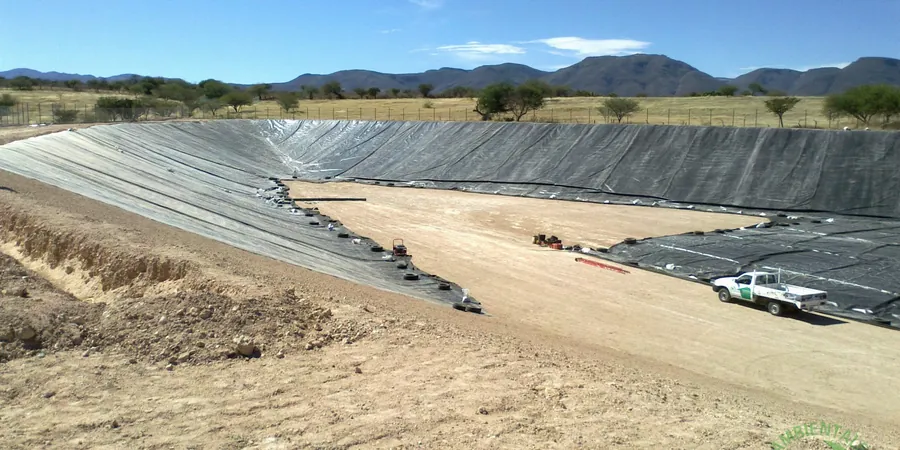
Houston sits on over 40 feet of Quaternary alluvial clays and sands, a legacy of the Brazos and Trinity river systems. This deep, compressible profile directly impacts landfill geotechnics: liner systems must resist differential settlement, and gas extraction wells need careful sealing. We assess these conditions through borings, piezocone tests, and laboratory consolidation trials. Before designing any cell, we complement the investigation with a permeability test to verify hydraulic conductivity in the native clay liner. Our work follows ASTM protocols and local Houston regulations for solid waste facilities.
A one-foot differential settlement across a liner system can tear a geomembrane and cause an uncontrolled leachate release.
Methodology and scope
High humidity and an average annual rainfall of 49 inches make Houston a challenging environment for landfill geotechnics. Water infiltration accelerates leachate generation, so cover systems must incorporate low-permeability barriers. We use double-ring infiltrometers and Guelph permeameters in the field. In the lab, we run flexible-wall permeability tests on compacted clay liner samples under confining pressures that mimic 30-foot waste lifts. The team also performs long-term creep tests to predict settlement of the waste mass over 20 years. This data helps engineers design leachate collection networks that won't clog or rupture under load. We often cross-check results with consolidation testing on the underlying foundation soils.
Technical reference image — Houston
Local considerations
We run a Geoprobe 7822DT with a lined soil sampling system for landfill geotechnics in Houston. This rig collects 3-inch Shelby tubes without cross-contamination from adjacent waste zones. The operator logs every refusal and water ingress. A single undetected void in the foundation clay can later cause a catastrophic liner tear. Our QA/QC protocol includes field density tests every 500 square feet of compacted clay liner, with results checked against the project's compaction curve. We also install vibrating-wire piezometers to monitor pore pressure buildup during waste placement.
Compacted clay liners, geomembrane compatibility, hydraulic conductivity testing, and quality control during construction.
02
Slope Stability Analysis
Limit equilibrium and finite element models for waste slopes, cover systems, and foundation soils under static and seismic loads.
03
Settlement & Subsidence Evaluation
Primary and secondary compression testing of waste and foundation soils, plus long-term monitoring with settlement plates.
04
Leachate & Gas Management Geotechnics
Permeability of drainage layers, gas extraction well design, and assessment of clogging potential in leachate collection pipes.
Applicable standards
ASTM D5084 (flexible wall permeability), ASTM D1586 (SPT for foundation soils), ASTM D2487 (USCS classification), RCRA Subtitle D (liner & leachate requirements), Texas Commission on Environmental Quality (TCEQ) Rules for Municipal Solid Waste
Frequently asked questions
What is the typical cost of a landfill geotechnical investigation in Houston?
For a medium-sized cell (10–20 acres), the investigation including borings, lab testing, and a report typically ranges between US$2,210 and US$8,800. Large multi-phase landfills can exceed that range depending on the number of borings and testing requirements.
How deep do you drill for landfill geotechnics in the Houston area?
Drilling depth depends on the waste height and foundation conditions. For a 50-foot waste column, we typically drill 80 to 120 feet into the underlying clay to evaluate consolidation potential and bearing capacity. The Beaumont clay formation often requires deeper borings.
What tests are most critical for a clay liner in Houston?
The three most important are: (1) flexible-wall permeability (ASTM D5084), (2) standard Proctor compaction (ASTM D698), and (3) Atterberg limits (ASTM D4318). These determine if the clay can achieve the required hydraulic conductivity of 1×10⁻⁷ cm/s after compaction.
Do you handle gas extraction well design as part of landfill geotechnics?
Yes. We evaluate the gas generation rate using the LandGEM model, then design well spacing and screen lengths. We also test the native soil's air permeability around the wells to ensure adequate vacuum influence.
Location and service area
We serve projects across Houston and its metropolitan area.